
Quick answer
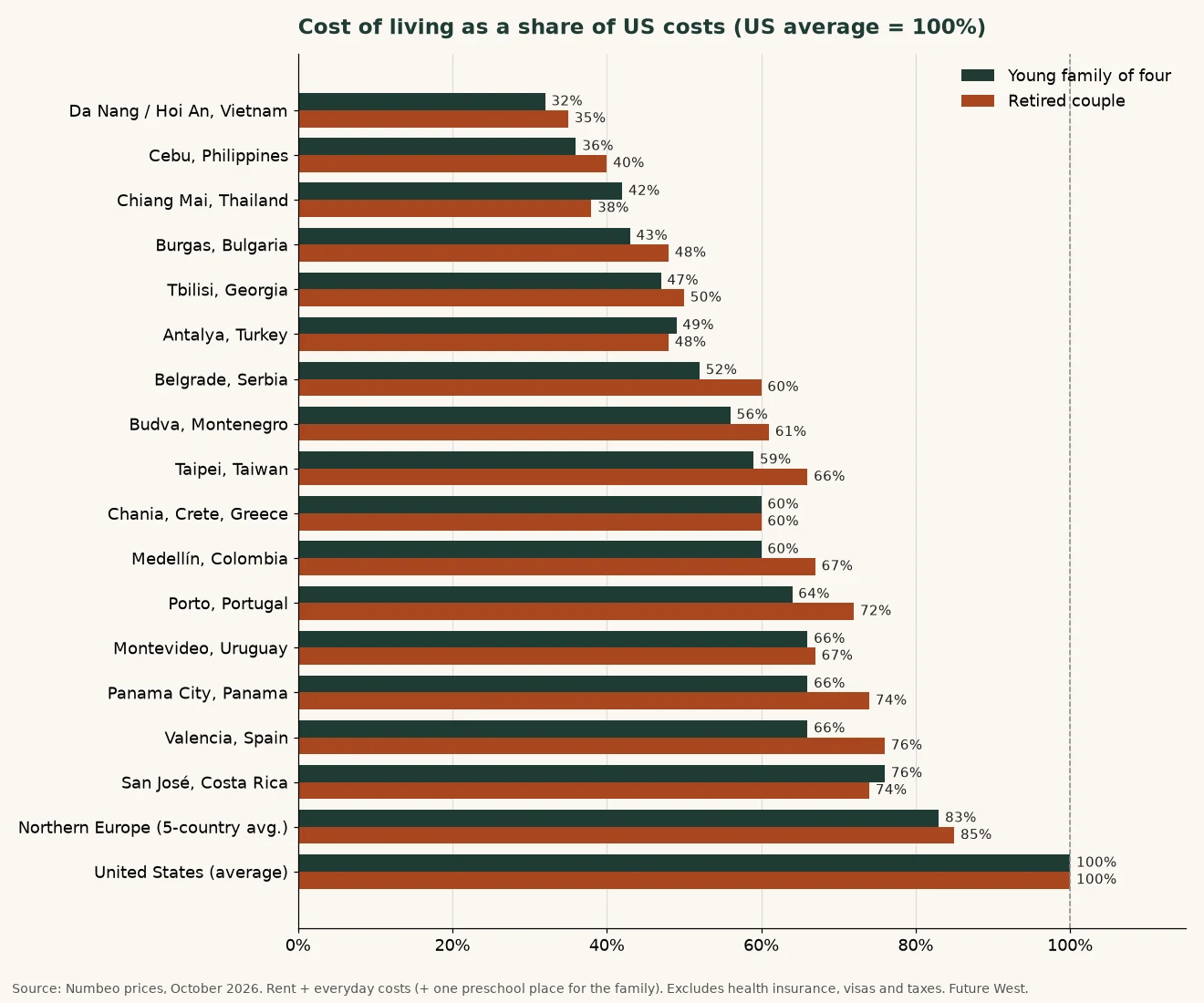
The cost of living abroad can be a fraction of what Americans pay at home. Using Numbeo prices from October 2026, a young family of four spends about 68% less in Da Nang or Hoi An, Vietnam, than at average US prices, 64% less in Cebu and 58% less in Chiang Mai. A retired couple spends 62% to 65% less in the same three cities. All 16 expat cities we compared cost less than both the US and our Northern European average.
We show the results as percentages of US costs. Prices change every year, but the gaps between countries move slowly, so the ranking stays useful long after the dollar amounts are out of date.
The tax break few Americans know about: if you live and work abroad, the foreign earned income exclusion lets you earn up to $132,900 a year per person free of US federal income tax. How much it saves depends on your income and family. We work through a $100,000 example for a family with two children further down.
Note: This article is general information, not financial, tax or immigration advice. Prices are crowd-sourced averages and visa rules change. Check current figures and get advice for your own situation.
Who is this for?
This guide is for Americans who already know what life abroad feels like: people who have traveled outside the US, ideally for more than a short resort holiday, and are now weighing a move for lower costs, a calmer life or a plan B. If you have never left the US and have no international travel experience, this is not for you yet. A cheaper budget on paper will not carry you through a new language, unfamiliar paperwork, a different health system and being far from family.
If that is you, start by traveling. Get a passport, pick two or three cities from the list below and visit them, one at a time. Stay a few weeks rather than a few days, and rent an apartment instead of a hotel so you shop, cook and get around like a resident. Visit in the off-season, too, when the weather is worse and the tourists are gone. Notice what daily life costs, how easy it is to see a doctor, how you handle the language and whether you still like the place after the novelty wears off.
Many people who later move abroad started exactly this way: a few trips, then a longer stay of one to three months, then a first year on a visa. By the time you sign a lease, you know the neighborhood, you have a few contacts and the numbers in this guide are no longer abstract. Leaving in time works best when it is a step you have tested, not a leap.
How we compared the cost of living abroad
We took the 14 second-residence countries from our article Fight or Flight: What History Teaches About Leaving in Time, picked one popular expat city in each, and added Chania on Crete and Tbilisi in Georgia. We compared them with the US national average and a Northern European average of Germany, the Netherlands, Denmark, Sweden and the United Kingdom, the kind of high-cost countries many expats leave. All prices come from Numbeo, a crowd-sourced price database, collected in October 2026.
Example 1: a US family of four, just starting out. Two adults and two young children, one in private full-day preschool, renting a three-bedroom apartment outside the city center. Everyday costs use Numbeo’s estimate for a family of four excluding rent: groceries, eating out, transport, utilities, phone, internet, clothing and leisure (Numbeo methodology).
Example 2: a US retired couple. Two adults renting a one-bedroom apartment in the city center, close to shops, cafés and doctors. Everyday costs use twice Numbeo’s estimate for a single person, slightly on the high side, since a couple shares utilities and internet.
Not included: health insurance, visa fees, a car, flights home and taxes. Health insurance in particular can change the picture.
Scoring: each place gets a score from 1 (most expensive) to 10 (cheapest), scaled between the cheapest and the most expensive place in the comparison.
Cost of living abroad: the results
Cost is shown as a share of average US costs (US = 100%), so 32% means about 68% less than in the US. The score runs from 1 (most expensive) to 10 (cheapest).
| City | Family of four | Retired couple |
|---|---|---|
| Da Nang / Hoi An, Vietnam Asia | 32% Score 10 | 35% Score 10 |
| Cebu, Philippines Asia | 36% Score 10 | 40% Score 9 |
| Chiang Mai, Thailand Asia | 42% Score 9 | 38% Score 10 |
| Burgas, Bulgaria Europe | 43% Score 9 | 48% Score 8 |
| Tbilisi, Georgia Europe/Asia | 47% Score 8 | 50% Score 8 |
| Antalya, Turkey Europe/Asia | 49% Score 8 | 48% Score 8 |
| Belgrade, Serbia Europe | 52% Score 7 | 60% Score 7 |
| Budva, Montenegro Europe | 56% Score 7 | 61% Score 6 |
| Taipei, Taiwan Asia | 59% Score 6 | 66% Score 6 |
| Chania, Crete, Greece Europe | 60% Score 6 | 60% Score 6 |
| Medellín, Colombia South America | 60% Score 6 | 67% Score 6 |
| Porto, Portugal Europe | 64% Score 6 | 72% Score 5 |
| Montevideo, Uruguay South America | 66% Score 6 | 67% Score 6 |
| Panama City, Panama Central America | 66% Score 6 | 74% Score 5 |
| Valencia, Spain Europe | 66% Score 6 | 76% Score 4 |
| San José, Costa Rica Central America | 76% Score 4 | 74% Score 5 |
| Northern Europe (5-country average) Northern Europe | 83% Score 3 | 85% Score 3 |
| United States (average) North America | 100% Score 1 | 100% Score 1 |
Three Asian cities lead both lists: Da Nang / Hoi An, Cebu and Chiang Mai, each at roughly a third to two fifths of US costs. Burgas, on Bulgaria’s Black Sea coast, is the cheapest European option, and Tbilisi, Antalya and Belgrade follow at about half of US costs. The Iberian favorites, Porto and Valencia, come in at about two thirds of US costs for a family, mostly because of rent. San José, Costa Rica, is the most expensive destination on the list, at about three quarters of US costs.
What drives the difference
Rent is the biggest swing. A three-bedroom apartment outside the center costs about 25% of the US average in Chiang Mai and 28% in Burgas, but about 75% in Porto and 77% in Valencia. Preschool is the other big gap: from about 11% of the US price in Da Nang to 67% in San José. Everyday costs vary less, from about 38% of US levels in Vietnam to 88% in Costa Rica.
For a retired couple, Chiang Mai moves up thanks to cheap central one-bedroom apartments, at about 28% of the US average. Even the priciest destination for retirees, Valencia, costs about 24% less than the US.
Cost of living abroad: visas at a glance
Low prices only help if you can stay. The table links to the official page, or the best available guide, for each country’s digital nomad visa (for people who work remotely) and its retirement route. Income thresholds change often, so check the linked page before you apply. Rules as of October 2026.
| City | Digital nomad visa | Retirement visa or residence |
|---|---|---|
 Photo: Steffen Schmitz, CC BY-SA 4.0, Wikimedia Commons Da Nang / Hoi An, Vietnam | None; 90-day e-visa | None; repeat 90-day e-visas |
| Cebu, Philippines | Approved in 2025, not yet open | Special Resident Retiree’s Visa (SRRV), age 40+ |
 Photo: Takeaway, CC BY-SA 3.0, Wikimedia Commons Chiang Mai, Thailand | Destination Thailand Visa (DTV) | O-A retirement visa, age 50+ |
 Photo: Vassia Atanassova – Spiritia, CC BY-SA 4.0, Wikimedia Commons Burgas, Bulgaria | Digital nomad residence permit (new) | Visa D and residence permit for pensioners |
 Photo: Andrew Milligan sumo, CC BY 2.0, Wikimedia Commons Tbilisi, Georgia | None; up to 365 days visa-free for US citizens | None; residence permits (e.g. via property) |
 Photo: Sharon Hahn Darlin, CC BY 2.0, Wikimedia Commons Antalya, Turkey | Digital nomad visa | Short-term residence permit |
 Photo: JuJu939, CC BY-SA 4.0, Wikimedia Commons Belgrade, Serbia | None; temporary residence via self-employment | Temporary residence permit |
 Photo: Wolfgang Sauber, CC BY-SA 4.0, Wikimedia Commons Budva, Montenegro | Digital nomad residence permit | None; temporary residence (e.g. via property) |
| Taipei, Taiwan | Digital nomad visa | None; no retirement route |
 Photo: Moonik, CC BY-SA 3.0, Wikimedia Commons Chania, Crete, Greece | Digital nomad visa | Financially independent person (FIP) visa |
| Medellín, Colombia | Visa V digital nomad | Visa M pensionado |
 Photo: Diego Delso, CC BY-SA 3.0, Wikimedia Commons Porto, Portugal | D8 digital nomad visa | D7 passive income visa |
 Photo: Intendencia de Montevideo, CC BY-SA 4.0, Wikimedia Commons Montevideo, Uruguay | Digital nomad permit | Permanent residence for foreign retirees |
 Photo: RB Photo, CC BY 2.0, Wikimedia Commons Panama City, Panama | Remote worker short-stay visa | Pensionado visa |
 Photo: LiteraryTech, CC BY-SA 4.0, Wikimedia Commons Valencia, Spain | Digital nomad visa | Non-lucrative visa |
| San José, Costa Rica | Digital nomad stay | Pensionado residency |
US taxes: the foreign earned income exclusion
The US taxes its citizens on worldwide income, wherever they live. But if you work abroad, the foreign earned income exclusion (FEIE) lets you exclude up to $132,900 of foreign earned income per person from federal income tax for 2026 (IRS). If both spouses work abroad and qualify, that is up to $265,800 for a couple.
To qualify, your tax home must be in a foreign country and you must pass one of two tests (IRS):
- Bona fide residence test: you are a genuine resident of a foreign country for an uninterrupted period that includes a full tax year. This is what people often call the “residence exemption.”
- Physical presence test: you spend at least 330 full days outside the US in any 12-month period.
On top of the FEIE, the foreign housing exclusion covers part of your housing costs abroad: rent and utilities above a base amount of $21,264 for 2026, up to a general limit of $39,870, with higher limits in expensive cities (IRS Notice 2026-25). Employees use the exclusion; self-employed people claim a foreign housing deduction instead (IRS).
Example: a family of four earning $100,000
Take a married US couple with two children under 17 and $100,000 a year in salary, filing jointly. For 2026 the standard deduction for a married couple is $32,200, the 10% bracket runs to $24,800 and the 12% bracket to $100,800 (IRS), and the child tax credit is $2,200 per child (Tax Foundation).
| Household, 2026 | US federal income tax living in the US | With the FEIE abroad | Yearly saving |
|---|---|---|---|
| Family of four, $100,000 in salary | about $3,240 (after $4,400 in child credits) | $0 | about $3,240 |
| Family of four, $150,000 in salary | about $10,940 | $0 | about $10,940 |
| Single person, $100,000 in salary | about $13,170 | $0 | about $13,170 |
For the $100,000 family, the exclusion saves about $3,240 a year, a real but modest sum, because the child tax credit already cancels much of a family’s federal tax at home. The saving grows quickly with income. And if you claim the exclusion, you lose the refundable part of the child tax credit (IRS). It pays off most for singles and for families on higher incomes. If both parents earn abroad, each can exclude up to $132,900. Your state income tax may also end once you stop being a state resident, but some states make that hard, so check your state’s rules.
Also, the exclusion covers federal income tax only. Social Security and Medicare taxes usually still apply, and your new country may tax your income too. Where local tax is high, the foreign tax credit can work better than the exclusion. Run the numbers both ways with a tax adviser before you file.
In practice, the housing break matters only where housing is expensive. For our family, rent and utilities exceed the $21,264 base only in Porto, Valencia and the Northern European average. In the cheaper cities, the FEIE alone does the work.
One trap for freelancers and online business owners: the FEIE does not reduce self-employment tax (IRS). That tax is 15.3% for Social Security and Medicare (IRS). A self-employed parent earning $100,000 abroad still owes about $14,100 a year in self-employment tax, with or without the exclusion. Some countries have social security agreements with the US that change this, so check before you move.
US taxes for retirees abroad
For the retired couple, the FEIE doesn’t help. Pensions, annuities and Social Security benefits are not foreign earned income (IRS), so they stay taxable in the US exactly as before. Some destination countries also tax pensions or foreign income brought into the country, while others tax only local income. Ask a tax adviser who knows both countries, and use the foreign tax credit to avoid paying twice on the same income.
What the numbers don’t show
- Health care: private health insurance and out-of-pocket costs vary widely and can be the biggest line in a retiree’s budget.
- Visas: each country has its own income, savings and health insurance requirements. See the visa table above and check the official pages.
- Lifestyle: imported food, international schools and Western-style apartments cost more than the local averages shown here.
- Currency risk: if your income is in dollars, a weaker dollar makes everything abroad more expensive.
- City vs country: we compared one popular expat city per country with national averages for the US and Northern Europe. Smaller towns are usually cheaper.
If you are weighing a move, the cost of living abroad is only one piece; start with the plan B steps in Fight or Flight.