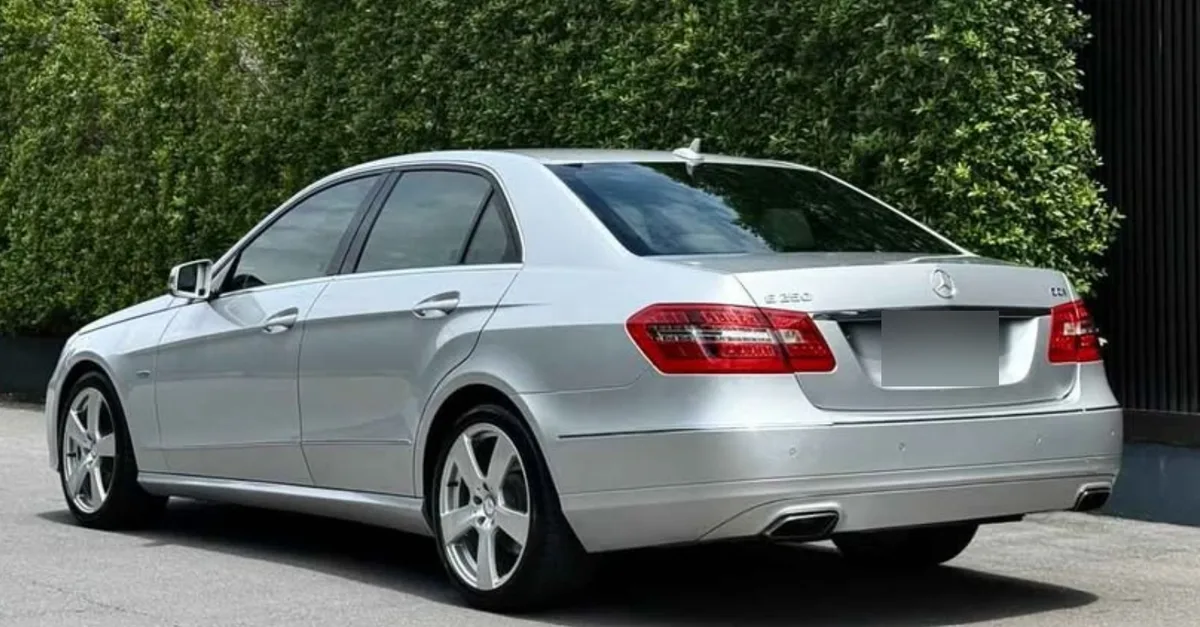
Buying an old car is one of the few big purchases where someone else has already paid most of the price for you. When I went shopping for a car in Thailand, one ad said its Mercedes E-Class had sold new for more than 5 million baht (about US$149,000). Sixteen years later, the asking price was 399,000 baht (about US$11,900). Somebody had already absorbed more than 90% of that car’s value. My job was only to figure out whether the part that was left was worth having.
That is the whole idea behind this article. You don’t need a new car to get a good car. You need the right old car, the right engine, and a plan to keep it until it dies.
This article is about old-school combustion engines: petrol and diesel cars you can buy, fix and run for years. Electric cars paired with solar panels and a home battery get their own article.
Quick answer
Let the first owner pay for depreciation. Buy an older car with a proven, simple drivetrain and a documented service history, plan to keep it for as long as it runs, and set aside a repair fund for the big jobs you know are coming. Judge the car the way you would judge a small business: clean records, low hidden debt and predictable costs.
Money isn’t the only reason to stay with older cars
Cheap entry is the obvious argument. But the longer I looked at new cars, the more I found other reasons to stay with an older one. Modern cars are increasingly computers on wheels, and that changes who is really in control of them.
The car can refuse to start
A friend of mine in Thailand bought a new Chinese car. After a software update, it wouldn’t start. Nothing was broken in the mechanical sense. The car’s own software had decided it wasn’t going anywhere.
On a much larger scale, the same thing happened in Russia in late 2025. The Moscow Times reported that hundreds of Porsches across the country became undriveable after a failure in their factory satellite security system, which cut the engine or blocked fuel delivery. Porsche had stopped deliveries to Russia in 2022 after the invasion of Ukraine, so owners had no official support. The cause was never confirmed. A large Russian dealer group suggested it might have been deliberate, while Porsche told heise online it wasn’t responsible and complied with all sanctions. Some owners got their cars running again only by disconnecting the battery for hours or removing the alarm module.
Whatever the cause, the lesson is the same. A car that depends on a connection to a server, a satellite or a software update can be switched off by events you don’t control: a bad update, an expired service, a war or a sanctions decision.
Everything is wired to everything else
A modern car isn’t one machine. It is dozens of computer modules talking to each other over a shared data network. One technician who spent seven years at a Toyota dealership says in his video that a 2015 Ford F-150 he scanned had 37 different computer systems communicating with each other. When one module or a piece of that network fails, it can disable functions that seem unrelated, and finding the fault takes expensive scan tools and time.
The same video explains why many mechanics choose older cars for themselves:

Cheaper parts may be rejected
On many newer cars, a replacement part has to be electronically paired with the car before it will work. Industry groups call this “parts pairing.” Australia’s Australian Automotive Aftermarket Association describes the problem: an independent mechanic can diagnose the fault and fit a safe, suitable part, but the car won’t recognize or switch it on without the manufacturer’s approval. The association also notes that many aftermarket parts come from the same factories that supply the carmakers, and the main difference is the brand on the box.
That pushes owners back to dealers and dealer prices. An older car usually accepts a quality aftermarket part, so you can shop around.
The car overrides the driver
In the EU, every new car sold since July 7, 2024, must have lane-keeping assistance, automatic emergency braking and intelligent speed assistance, according to the European Commission. These systems save lives in many situations. They can also misread ordinary driving.
I found that out in Germany with brand-new rental cars. Slowly easing out of a side road into traffic, the way you do every day in Thailand, the car decided I was about to crash and slammed on the brakes. False braking isn’t unusual either. In the United States, Nissan told regulators about more than 1,200 consumer complaints of its automatic braking activating without a real threat, according to Automotive News.
To be fair, a 2010 Mercedes is not a simple 1970s car. It has its own electronics and computer modules. But it comes from before mandatory driver-assist systems, always-online connections and over-the-air updates. Its weak points are known, and independent mechanics have had more than 15 years to learn how to fix them.
Why I think German engineering peaked around 2015
This is my opinion, not a lab result. But I believe German car engineering peaked around 2015. After that, German cars got more expensive and more complex, and they lost the quality that made them worth buying. I think the same is true of American cars.
2015 is not a random year. In September 2015, the Dieselgate scandal broke. Volkswagen had installed illegal software in 11 million diesel cars to cheat emissions tests, according to The Verge. VW set aside 22.6 billion euros for fines and compensation (DW). From then on, the German industry’s money and attention moved toward software, screens, electrification and compliance, and away from the long-lived engines it was famous for.
The owner surveys point the same way. In J.D. Power’s 2019 Germany Vehicle Dependability Study, all three German premium brands, Audi, BMW and Mercedes-Benz, ranked below the industry average in their own home market. Volvo and most major volume brands ranked well above them. Volkswagen’s in-house software unit, Cariad, became known for delays and problems, and VW recalled nearly 80,000 ID.4 electric cars in 2024 over infotainment faults that affected the rearview camera and speedometer (ConsumerAffairs).
American brands haven’t done better. In 2025, Ford issued 153 recalls covering almost 13 million vehicles, the most any carmaker has ever issued in one year, according to Kelley Blue Book. Dozens were repeat recalls just to install the correct software, as Kelley Blue Book reported earlier in the year. Prices climbed too. Based on Kelley Blue Book transaction data, CarEdge calculates that the average new car in the US went from $34,428 in December 2015 to $50,326 in December 2025. Ford’s average rose almost 58% and Stellantis’s (Chrysler, Jeep, Ram, Dodge) about 60%, well ahead of inflation.
Part of that increase across the whole market is plain inflation and buyers choosing bigger trucks and SUVs. But you pay more and get a car that is more complicated, harder to repair and more dependent on software. That is why my shortlist stopped at the last generation built before the change.
Timeless elegance that new cars have lost
There is one more reason, and it has nothing to do with spreadsheets. Older cars like the E250 CDI are simply beautiful in a way many of today’s models aren’t.
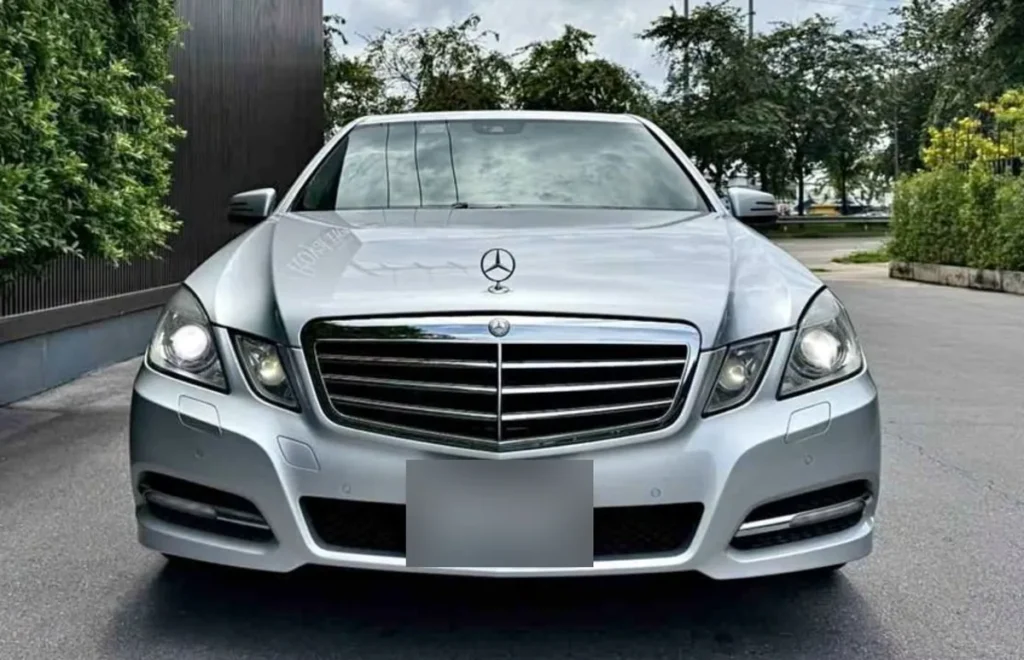
Look at the front of this car. It has a classic chrome grille with horizontal slats, the star standing up on the hood, and clean lines from one end to the other. It is a three-box sedan shaped like a sedan should be: long, low and calm. It doesn’t shout. Fifteen years on, it still looks right parked in front of a hotel, a business meeting or a wedding.
Many new cars have gone the other way. Grilles have grown oversized, headlights have shrunk into angry slits, and almost everything has turned into a tall SUV. The designs are made to stand out in the showroom this year, and that kind of styling tends to age fast.
The inside tells the same story.
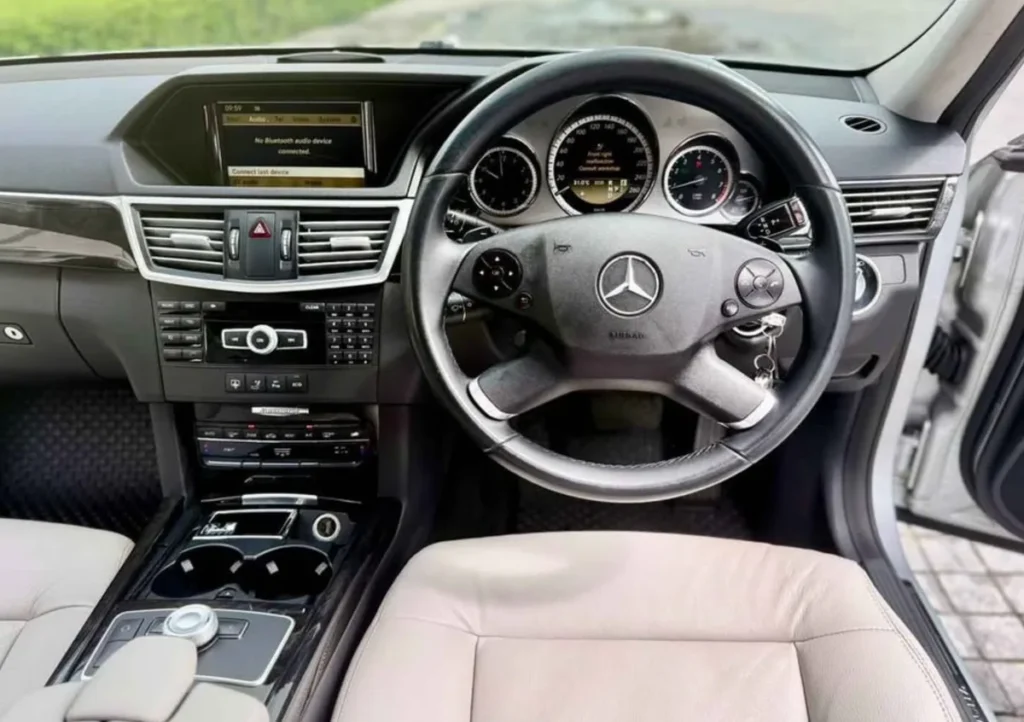
This cabin has proper round instruments, a row of physical buttons for the climate and audio, a rotary controller, wood trim and leather seats. You can adjust the air conditioning without taking your eyes off the road. In many new cars, the same job means tapping through menus on a large touchscreen.
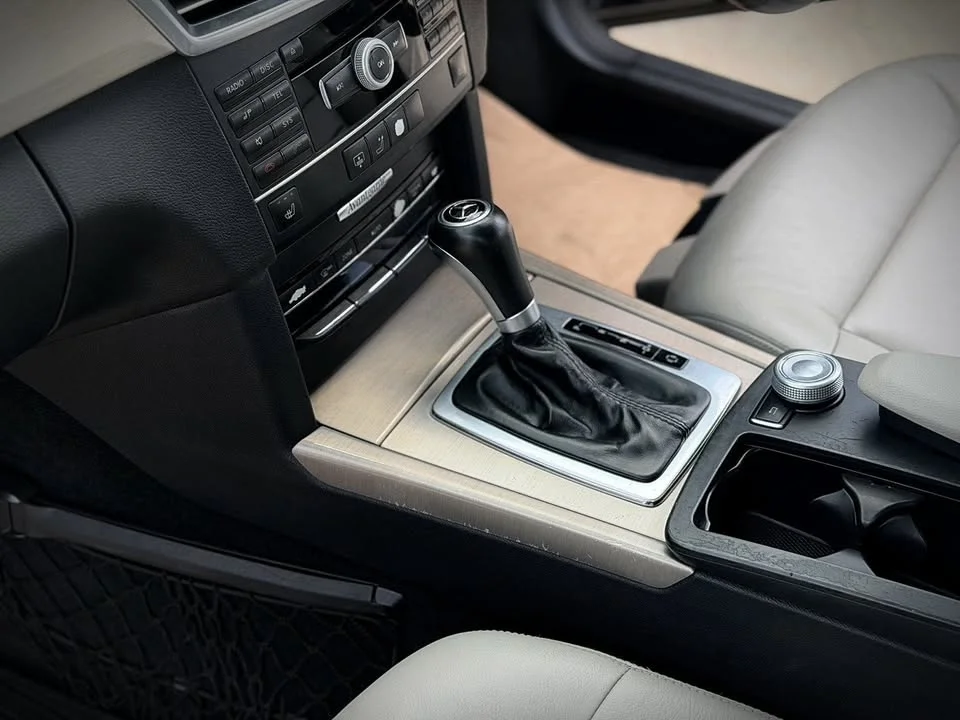
That isn’t only a matter of taste. In 2026, Europe’s crash-test body started rewarding physical controls again. According to Euro NCAP, indicators, wipers, hazard lights, horn and the emergency call button should be operated by a direct physical input rather than hidden in a touchscreen menu. Its director of strategic development, Matthew Avery, called the overuse of touchscreens “an industry-wide problem” that raises the risk of distraction crashes, as reported by RAC Drive. The industry is now slowly putting back what cars like the E250 CDI never took away.
Depreciation is the biggest cost nobody budgets for
A new car loses value fastest in its first few years. According to Kelley Blue Book, new cars lose about 30% of their value over the first two years and keep losing 8–12% a year after that. Kelley Blue Book’s depreciation guide adds that cars often lose about 55% of what they cost within five years.
Luxury cars fall even harder. They are expensive to buy, expensive to fix out of warranty, and most second owners don’t want the risk. That fear is exactly what creates the bargain. A 15-year-old executive sedan can cost about the same as a basic new hatchback, while giving you a stronger body, a better ride and safety equipment that was top of the range in its day.
The catch is that an old luxury car can also ruin you. The difference between a bargain and a money pit comes down to a few rules.
My rules for buying an old car
Before I looked at a single ad, I wrote down what the car had to do. These were my criteria:
- An “indestructible” drivetrain. I wanted an engine and gearbox with a long record of high mileage, ideally the kind taxi drivers use.
- Low, predictable maintenance. No exotic systems that fail without warning and cost a fortune to diagnose.
- A long-term hold. I wasn’t buying to resell in three years. The plan was to keep the car until it died.
- Clean history. Full dealer service records, genuine mileage and no accident damage.
I treated it the same way I treat buying a website or a small business. You pay for clean history, low hidden debt and predictable future costs. A cheap asset with unknown problems isn’t cheap.
Why the Mercedes W212 E-Class made the shortlist
In Thailand, the 2010–2016 Mercedes E-Class (model code W212) is everywhere. It also comes from what I consider the last good years of German engineering. That matters. A common car means mechanics know it, parts are easy to find and you can compare dozens of listings. In mid-2026, most 2010–2014 W212 sedans I saw were advertised between roughly 350,000 and 600,000 baht (about US$10,400 to US$17,900), depending on engine and year.
The W212 also has a solid reputation for durability when it is maintained. But the platform was only half the decision. The engine was the other half.
The engine matters more than the badge
The same car can be a safe bet or a gamble depending on what is under the hood. My first choice was clear from the start: the E250 CDI.
Its four-cylinder diesel (Mercedes calls it the OM651) is the kind of engine my rules were written for. It is the taxi-grade workhorse of the W212 range, and the taxi trade is the best proof of what it can do. For decades, the diesel E-Class was the standard taxi across Europe. In Germany, Mercedes supplied more than half of all newly registered taxis as recently as 2019, according to Carscoops.
Taxi operators don’t buy a car for its badge. They buy it because it keeps earning. German used-car inspectors at checkdenwagen.de note that W212 taxis with 300,000 to 500,000 kilometers (about 186,000 to 311,000 miles) are common on the used market. According to Gebrauchtwagenberater, many OM651 engines have gone well past 500,000 kilometers when properly looked after. Taxi drivers and high-mileage owners on the Autodoc Club forum regularly report 350,000 to 500,000 kilometers, with oil changes every 10,000 to 15,000 kilometers (about 6,000 to 9,000 miles). The OM651 is also far more economical than the big petrol engines, especially on the highway. Thai owners and dealers often call the E250 the retiree’s favorite for exactly that mix of durability and economy.
It isn’t perfect. The diesel has its own weak spots: injectors, the high-pressure fuel pump, the timing chain and the soot filter and exhaust recirculation system, which clog up with too many short trips. Earlier engines had more of these problems than later ones, so the newer the better.
Here is how the E250 CDI compared with the other W212 options I looked at:
| Engine option | Why it appealed | Why I hesitated |
|---|---|---|
| E250 CDI (four-cylinder diesel), my first choice | Taxi-grade durability when serviced on time; long engine life; low fuel use on the highway | Injectors, high-pressure fuel pump, timing chain and soot filter problems, especially with short city trips |
| E300 3.0 V6 petrol | No diesel emissions hardware; handles short trips well; smooth and simple by comparison | Higher fuel bills; some known V6 weak spots to check |
| E300 BlueTEC Hybrid | Newer years, strong torque, good economy | Hybrid and gearbox failures that local mechanics warned against; complex and costly to fix |
The hybrid was an easy no. It looked like good value on paper, but it added exactly the kind of complexity I was trying to avoid.
The petrol E300 was the alternative I kept coming back to. For lower mileage and a mix of short trips, it avoids the diesel’s emissions equipment, and Thai mechanics on local forums often give older-car buyers the same advice: buy petrol, it is easier to look after. But on durability alone, the E250 CDI was still my pick.
Why the Strait of Hormuz settled the diesel question
What finally moved me away from the E250 CDI had nothing to do with price or mechanics. It was standing at pumps that had none.
After the Strait of Hormuz crisis began in early 2026, diesel ran out at stations across northern Thailand. In March, The Star reported that many Chiang Mai stations were getting less than 10,000 liters of diesel a day, which sold out within hours. Some put up “diesel sold out” signs, capped private cars at 700 baht (about US$21) of diesel and banned filling jerry cans. In one Chiang Mai district, Chiang Mai Citylife reported that a rescue unit had to suspend patient transport because every pump nearby had run out of diesel. In Prachinburi, Thairath found stations with “diesel sold out” signs that still had Benzene 91 and E20 petrol left.
Petrol ran short at some stations too, but diesel was hit first and hardest. For a car you plan to keep for 10 years or more, that matters more than a few baht per liter. A car you can’t fill is worth nothing on the day you need it.
The reason is in the crude itself. Oil from the Persian Gulf isn’t the only source of diesel, but it is unusually rich in it. Commodity analysts at Kpler describe the region’s export crude as “inherently middle distillate rich” (middle distillates are diesel and kerosene, which includes jet fuel). The Middle East also supplies about 15% of the world’s seaborne diesel and jet fuel exports. So when Gulf oil stops moving, diesel and kerosene are hit hardest, while petrol suffers less.
That is exactly what happened in 2026. The Center on Global Energy Policy at Columbia University reports that diesel faced the largest crunch of any fuel, with disruptions hitting 20% of global seaborne diesel shipments and jet fuel trade down by about a third. Asia felt it first. According to The Daily Star, Asia was the destination for about 80% of the cargoes that passed through the strait before the war, and Asian exports of refined fuels such as diesel and jet fuel fell to multi-year lows.
The lesson for a long-term car owner: diesel is a supply risk. If you plan to keep a car for 10 years or more, you will probably live through another disruption like this one. A petrol engine keeps you on the more widely available fuel.
Check the known weak spots before you buy
Every engine has a reputation, and the internet will tell you about its worst failures. The trick is to find out whether those failures apply to the specific car in front of you.
The petrol V6 in the E300, my fallback once diesel was off the table, is a good example. Mercedes calls it the M272. Early versions had a balance shaft gear that wore out too soon, and the repair means removing the engine. According to Wikipedia’s M272 entry, the problem mainly affected engines sold from 2004 to 2007 with serial numbers up to 2729..30 468993, and repairs cost more than $4,000. Bavarian Dismantlers explains that engines above that serial number have the revised material.
So for a 2010 car, the worst-known failure is far less likely, but not something to assume. You check the engine number and you ask a specialist to scan the car. That is the kind of homework that turns a scary engine into a known risk.
The petrol fallback with its homework done
I didn’t end up buying a Mercedes (more on why below). But once diesel was off the table, one petrol E300 showed what a good old car looks like, and it wasn’t the cheapest car I saw. It was a 2010 car with about 80,000 kilometers (about 50,000 miles), a full dealer service history and, according to the seller, around 300,000 baht (about US$8,900) of recent work at a Mercedes dealer: new shock absorbers and mounts, plus fresh gearbox, differential, engine and coolant fluids.
That spending was the point. A big share of the maintenance an old car needs had already been paid for by the previous owner, if the invoices matched the claim. Buying an old car with its catch-up maintenance done is like buying a house with a new roof.
How to buy an old car without regretting it
If you want to try this yourself, here is the checklist I used:
- Write your rules first. Decide on drivetrain, mileage, budget and how long you will keep the car before you read a single ad.
- Pick the engine, not just the model. Research which engines in that model have the best long-term record and which to avoid.
- Demand records. Ask for the full service history and itemized invoices. Check that the mileage matches the service stamps and the wear on the car.
- Get an independent inspection. Pay a specialist who knows the model to scan the car and look for leaks, accident repairs and known weak points.
- Ignore the monthly payment pitch. Look at the total price, interest rate and fees. Pay cash if you can.
- Budget for the big jobs. Assume a few major repairs over the car’s remaining life. Spread that cost over five to eight years and see whether the numbers still work.
- Maintain ahead of schedule. Change fluids, rubber parts and cooling-system components early. That is what keeps a run-it-to-death car alive.
- Ask your mechanic before you buy. Ask the mechanic who will look after the car whether he can fix this model, whether he can get the parts and whether he has the right diagnostic system for it. A great car is a bad buy if nobody near you can keep it running.
Why I didn’t buy the Mercedes after all
The whole search started with an accident. My wife damaged our 14-year-old SUV, and I was sure that was the end of it. A car that old, with that much damage, looked like a write-off. So I started shopping for a replacement.
Then our mechanics brought it back to life. The SUV is still on the road, and the Mercedes stayed in the ad.
That is another reason buying an old car makes so much sense in a country like Thailand. Labor is cheap compared with Europe or the US. Thailand’s legal minimum wage is 337 to 400 baht (about US$10 to US$12) a day, depending on the province, according to Thai Law Online. Skilled mechanics earn more than that, but a day of their work still costs a fraction of a few hours in a Western workshop. So repairs that would be written off as uneconomical in Germany or the US are often well worth doing here. Mechanics straighten panels, rebuild parts and fix the problem instead of swapping whole assemblies.
In a high-wage country, the labor bill often decides that a car is “finished.” In Thailand, an old car is finished much later, and that makes it worth keeping, and worth buying.
Old cars and living on less
Buying an old car isn’t about being cheap. It is about refusing to pay the most expensive part of car ownership, the early years of depreciation, when you don’t have to. It also takes a car off the list of things that need to impress anyone. Nobody in the parking lot knows or cares whether your Mercedes is 15 years old. If you’ve read why we say to stop keeping up with the Joneses, this is the same idea on four wheels.
The money you don’t sink into a new car can go to savings, a plan B or a move abroad. And if you want to leave fuel prices behind completely, look out for our coming article on electric cars charged by solar panels and a home battery.
Frequently asked questions
Is buying an old car a good idea?
It can be, if you choose a model and engine with a long durability record, check its service history and set aside money for repairs. The savings come from skipping the steep early depreciation.
Are old luxury cars expensive to maintain?
They can be. Parts and labor cost more than for an economy car, and some engines have known expensive failures. Choose a common model with simple, proven mechanicals and full service records to keep costs predictable.
Should I buy a diesel or petrol old car?
For most long-term owners, petrol is the safer choice. It avoids diesel emissions equipment and high-pressure fuel system problems, handles short trips better, and runs on a fuel that was less exposed to the 2026 Strait of Hormuz disruption. Persian Gulf crude is rich in diesel and kerosene, so diesel supplies are hit harder when that oil stops flowing. Diesel still makes sense if you drive very high highway mileage and fuel is reliably available where you live.
Are new cars harder to repair than old cars?
Often, yes. New cars use dozens of linked computer modules, need expensive scan tools to diagnose, and may reject replacement parts that haven’t been electronically paired by the manufacturer. Older cars tend to accept quality aftermarket parts and can be fixed by more independent mechanics.
What model years are best for buying an old car?
In my view, cars built up to about 2015 are the sweet spot. They have modern safety basics and comfort, but they come before the wave of software-heavy designs, mandatory driver-assist systems and parts pairing. Check the specific model’s reliability record, because some engines from those years are much better than others.
What should I check before buying an old car?
Check the service records, verify the mileage, look up known problems for that specific engine and have an independent specialist inspect and scan the car before you pay.
Note: This article is general information about buying and keeping older cars, based on the author’s own experience. It is not mechanical, legal or financial advice. Have any car inspected by a qualified mechanic before you buy, and check local rules on registration, inspection and fuel.