
Quick answer
When it comes to fight or flight, history is clear: when a country enters hard times, the people who keep their savings, and sometimes their lives, are usually the ones who acted early. They moved money, gold or themselves somewhere stable before the doors closed. Those who kept everything in property at home were easy targets: houses and farms can’t move, so governments taxed, levied and in some cases took them. Weimar Germany, Nazi Germany, Zimbabwe, Argentina and Venezuela all followed that pattern. And because the world never moves in sync, there is always somewhere that is doing better. You can’t control the cycle, but you can choose where you sit it out.
Note: This article is general information, not financial, tax, legal or immigration advice. Moving money or residence across borders has rules. Follow them, and get professional advice for your situation.
Fight or flight
Every animal facing danger has two options: fight or flee. People facing hard times have the same choice. You can fight: stay where you are and make your household stronger with savings, a pantry, skills and lower bills. Or you can take flight: move part of your life, or all of it, to a place where things are going better.
Future West covers both. This article is about the second option, and about why it deserves a serious look. Not because leaving is always right, but because history keeps showing that people who kept the option open, and used it in time, did far better than those who waited.
In The Fourth Turning, historians William Strauss and Neil Howe describe history as moving in cycles of about 80 years, through four eras: a High, an Awakening, an Unraveling and a Crisis. In his 2023 follow-up, Howe dates the current Crisis era in America from the 2008 financial crash and expects it to run into the early 2030s (The Fourth Turning Is Here). The novelist G. Michael Hopf, inspired by their work, put the same idea in one line: “Hard times create strong men. Strong men create good times. Good times create weak men. And weak men create hard times” (G. Michael Hopf).
If that cycle is right, the question isn’t whether hard times come. It’s where you will be when they do.
Lesson 1: Geography is a choice
You don’t have to sit through the worst of a crisis if you have somewhere else to go. Five cases from the last hundred years show what that choice was worth.
Weimar Germany, 1923: savings in marks became worthless

After World War I, Germany paid for its war debts and reparations largely by printing money. In 1923 the mark collapsed. By November 1923 one US dollar cost 4.2 trillion marks (Britannica). A loaf of bread that cost 20,000 marks in the morning could cost 5 million marks by evening, a lifetime of savings would no longer buy a subway ticket, and pensions were wiped out (Britannica).
The losers were the careful ones: savers, pensioners and holders of government bonds, as Der Spiegel put it. The winners were borrowers and people who owned real assets, since debts could be repaid in worthless paper (Historisches Lexikon Bayerns).
Now picture a family that, a couple of years earlier, had moved its savings into dollars or Swiss francs, or had gone to work abroad for a few years. When Germany introduced the new Rentenmark in late 1923, the dollar was back at 4.20 marks (Der Spiegel). That family could have come home in 1924 with its savings intact, and its money would have bought far more than before. The neighbors who stayed in marks had nothing left.
Nazi Germany, 1933–1941: the price of leaving kept rising
This is the hardest example, and it needs care. The victims of Nazi persecution were never responsible for what was done to them. But their history holds a lesson about timing that is painful and important.
In January 1933 about 523,000 Jews lived in Germany (Holocaust Encyclopedia). Many left early, about 37,000–38,000 in 1933 alone, and by September 1939 about 282,000 had left Germany (Holocaust Encyclopedia).
What changed over those years was the cost of leaving:
- An exit tax that started as a normal law. The Reich Flight Tax was introduced in 1931, before the Nazis, as a 25% tax on the assets of wealthy emigrants to stop capital flight. In 1934 the threshold was cut from 200,000 to 50,000 Reichsmarks, so it hit the middle class too (Yad Vashem).
- Transfer losses on top. Money could only be moved abroad at punishing exchange rates. Emigrants between 1933 and 1937 had to leave behind, on average, more than three quarters of their assets (LSE working paper), and by 1938 emigrants lost more than 90% on average (Wikipedia: Reich Flight Tax).
- Then the door closed. In October 1941 Jewish emigration was banned (Holocaust Encyclopedia).
Leaving was also limited by the other side of the border. At the Evian Conference in 1938, 32 countries met to discuss the refugees, and almost none agreed to take more (Holocaust Encyclopedia). By June 1939, 309,000 German, Austrian and Czech Jews had applied for 27,000 places under the US quota (Holocaust Encyclopedia).
Two lessons follow. First, people who left early kept more of what they had, and many survived. Second, the hardest part was often not leaving, but having somewhere to go. A visa, a residence permit or a second passport arranged in calm times was worth more than any amount of money in a crisis.
Zimbabwe, 2008: the people with money abroad kept it
Zimbabwe’s hyperinflation peaked in mid-November 2008 at a monthly rate of 79.6 billion percent, the second highest in recorded history (Cato Journal, Hanke and Kwok). By the end of 2008, pensions, wages and investments were worthless, and at least eight in ten people were out of work (BBC). When the old currency was finally retired, bank balances of up to 175 quadrillion Zimbabwe dollars were exchanged for five US dollars (BBC).
Individuals who converted to foreign currency could save some of their wealth, while pensioners and businesses trapped by foreign-exchange rules were hit hardest (Polity). It happened again a decade later: in 2018 the central bank ordered banks to convert US-dollar deposits into the local currency at one to one, a rate far above its real value. Deposits from offshore accounts were the exception (SciELO, PER journal).
Read that again: the money that was already outside the system was the money that survived.
Argentina, 2001: once one of the richest countries in the world
In 1913 Argentina was richer than France or Germany, almost twice as prosperous as Spain, and its income per person was almost as high as Canada’s (Harvard Business School). Around 1910 it ranked among the ten richest countries in the world (Our World in Data). Over the following century it fell far behind, through repeated booms, busts and bouts of inflation.
Then came 2001. To stop a bank run, the government froze bank accounts in December and limited cash withdrawals to 250 pesos a week, at a time when one peso still equaled one dollar. Transfers abroad were in effect banned (NBER). In February 2002 dollar deposits were forcibly converted into pesos at 1.4 pesos per dollar (NBER), while the market rate soon jumped to about 4 (Wikipedia: Corralito). Argentina also defaulted on $82 billion of debt, at the time the largest sovereign default in history (US State Department).
Many Argentines had done the “safe” thing and saved in dollars. It didn’t help, because the dollars were inside Argentine banks. The rules applied to Argentine banks and to transfers out of the country (Marval O’Farrell Mairal), so money already held abroad was beyond their reach. Being rich once is no protection. What matters is where your savings sit when the rules change.
Venezuela, 2016–2021: an oil state that emptied out
Venezuela sits on some of the largest oil reserves in the world, and still its currency collapsed. Hyperinflation began in November 2016 (Cato Institute), and prices rose more than 1.6 million percent in 2018 alone (Peterson Institute). In August 2018 the government cut five zeros off the currency (Reuters).
Owners at home were hit along the way. A Venezuelan industry association estimated that the government had expropriated more than 1,400 private businesses since 1998, and by 2013 the National Land Institute claimed to have seized more than 8.9 million acres of land since 2002 (US State Department). Compensation was promised by law, but the process was slow and opaque (US State Department).
And people left. Nearly 7.9 million Venezuelans have left the country in search of protection and a better life (UNHCR), one of the largest displacements in the world today.
It’s not only history, and not only poor countries
Inside the European Union, Cyprus closed its banks in 2013 and limited cash withdrawals to €300 a day. At Bank of Cyprus, savings above €100,000 were turned into bank shares worth 37.5% of the deposit (Euronews). In 2015, Greece limited ATM withdrawals to €60 a day and banned transfers abroad (BBC). The controls on moving money abroad lasted until September 2019 (Yale Journal of Financial Crises).
The Netherlands, one of the richest countries in Europe, shows how fast the rules on savings can shift. In February 2026 the Dutch lower house approved a new tax on savings and investments with 93 of 150 votes (Tweede Kamer). It would tax actual returns at a flat 36%, including the yearly rise in value of investments you haven’t sold, so-called paper gains (Deloitte), and a cut to 35% has been discussed (SRA).
It is not law yet. The Senate has held off its vote, and in September 2026 the government announced changes that would tax shares, bonds and options only when sold from 2028, with crypto and foreign-currency accounts following from 2030 (PwC). Whatever the final version, the direction is plain: a state that needs money looks at savings that have grown, whether or not the owner has cashed in.
The pattern is always the same. First the currency or the banks get into trouble. Then the rules on moving money tighten. By the time most people decide to act, it’s harder and more expensive, or no longer possible. That is why the fight or flight decision belongs in calm times, not in the middle of the crisis.
Property owners at home were sitting ducks
A house or a farm can’t be moved. That made owners who stayed the easiest target once governments needed money, and governments came back to the same owners again and again.
In Weimar Germany, owners at first came out ahead: inflation wiped out their mortgages while their buildings kept their value. The state soon took that gain back. From 1924 a special tax on buildings built before mid-1918, the Hauszinssteuer, was levied on rental income to fund new public housing (Bundestag research service). The rules left owners enough rent to cover running and repair costs and taxed much of the rest away (GESIS study). The tax stayed in place until 1942 (Bundestag research service).
After World War II it happened again. West Germany’s 1952 burden-sharing law, the Lastenausgleich, charged a levy of 50% of assessed wealth, falling mainly on real estate and business assets, paid in quarterly installments over 30 years until 1979 (DIW Berlin). It paid compensation to refugees and bombed-out families, a fair cause. But for property owners it meant handing half their assessed wealth to the state, in the same generation that had lived through 1923.
In Zimbabwe, and later in Venezuela, owners of farms lost the land itself. From 2000 the government listed thousands of farms for compulsory acquisition without compensation (Human Rights Watch). By the end of 2004 about 9,000 farms were listed. Compensation, paid only for improvements and not for the land, was valued at 10–15% of independent valuations and had been offered to only about a quarter of dispossessed farmers (IMF).
Not every owner lost everything, and land is still one of the oldest stores of value. But land at home is wealth the state can always find, tax and, in the worst case, take. Money, metal and people can move. Land can’t.
Lesson 2: The world doesn’t move in sync
The Fourth Turning describes the history of America and the Anglo-American world. Other countries run on their own clocks. While one region is in its winter, another is in its spring.
Eastern Europe remembers
Central and Eastern Europe lived under communism until 1989. People there know from their own families’ experience what it means when the state controls the economy, the media and daily life.
The economic turnaround since then has been remarkable. Poland was the only economy in the European Union that avoided recession in the 2008–2009 crisis (World Bank). Its GDP per person rose from 38% of the EU average in 1990 to 82% in 2023 (Reason, using World Bank data), and it was among the fastest-growing large EU economies again in mid-2026 (Eurostat).
Many people in this region have seen where overreaching governments lead, and they are wary of following Western Europe down that road.
Asia is on the upswing
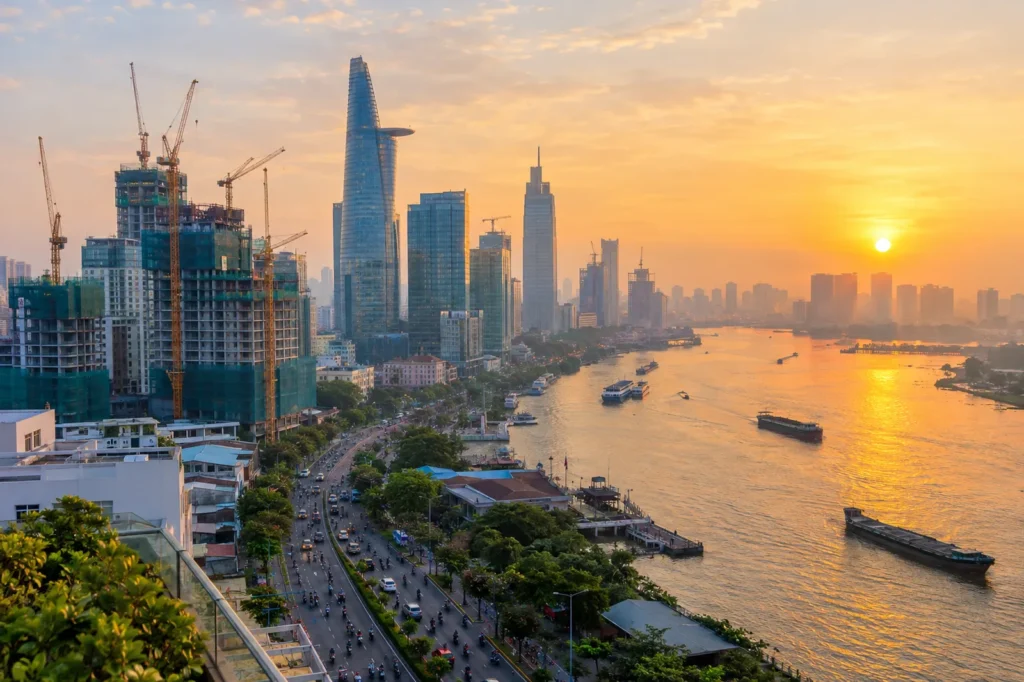
The IMF’s October 2026 outlook shows the gap in plain numbers (IMF, ICIS, UPI, Euronews):
| Economy | Forecast growth 2026 |
|---|---|
| Vietnam | 8.4% |
| India | 7.0% |
| Malaysia | 5.2% |
| Emerging and developing Asia | 5.1% |
| Indonesia | 5.1% |
| China | 4.5% |
| United States | 2.3% |
| Thailand | 2.1% |
| Germany | 1.3% |
| United Kingdom | 1.3% |
| Euro area | 1.1% |
| Canada | 1.1% |
| Japan | 0.7% |
Much of Asia is driven by a hunger for prosperity, much like America and Western Europe in the 1950s. These countries are building, not managing decline, and they have no wish to be dragged down with the West.
Growth isn’t everything. A slow-growing country can still offer far better value for money than the place you live now. And China grows fast, but it is not where most people would go for more personal freedom. Choose each place for what it’s good at.
Africa is young and growing
While Europe, Japan and China are aging, Africa is the youngest region on earth, with a median age of 19.2 years in 2024 (United Nations). Its population passed 1.5 billion in 2024 and is projected to reach 2.5 billion by 2050. By then Africa will have about 1.6 billion people of working age, roughly a quarter of the world’s workforce (United Nations).
The economies are moving too. The IMF expects sub-Saharan Africa to grow 4.5% in both 2026 and 2027 (IMF), several times the pace of the euro area. Countries such as Ethiopia, Guinea and Benin are among the fastest growing (The Africa Report).
Africa is also choosing its own partners. South Africa was already part of BRICS, the group led by Brazil, Russia, India and China. Egypt and Ethiopia joined as full members in 2024, and Nigeria and Uganda became BRICS partner countries in 2025 (Austrian Institute for International Affairs). Most of these countries still trade and work with the G7 as well. But like much of Asia, they no longer look only to the West, and they have no wish to share its decline.
Africa is not one country, and it carries real risks: heavy debt, conflict in some regions and, as Zimbabwe showed, weak property rights in others. The IMF also warns of rising inflation and debt-service costs (IMF). Pick countries one by one, not the continent as a whole.
Where this leaves you
At any moment, somewhere in the world prosperity is intact, costs are reasonable, and you are free to pursue your own happiness. Your job is to know where those places are, and to have a way to get there. Fight or flight is not a one-time choice between staying and leaving forever; it is knowing your options before you need them.
Lesson 3: Build your plan B before you need it
Expect your own circle to pull you back
There is an old image for this: lobsters in a basket. When one tries to climb out, the others grab it and pull it back in. The saying usually uses crabs in a bucket, and psychologists call it crab-bucket syndrome or crab mentality (Psychology Today). It’s a metaphor, not a study of shellfish, and people recognize it because it describes us so well.
Start talking about moving money abroad or moving yourself, and the pull usually comes from the people closest to you: family, friends, colleagues. “You’re overreacting.” “You’ll be back in a year.” “Who will look after your parents?” Most of them mean well. But your plan makes them question their own choices, and it’s easier to talk you out of yours. In every case above, staying looked like the sensible default and leaving looked like overreacting, until it was too late.
Listen to the practical concerns, ignore the guilt, and keep your plans to yourself until they’re settled.
Spread your life across flags
This is where flag theory comes in: instead of tying everything to one country, choose the best place for each part of your life. One place to live, others to bank and invest, the best environment for your family, and the best jurisdiction for your business. A company in one country, savings in another, a home in a third: if one of them turns against you, the others still stand.
You don’t need to do it all at once. Start with the steps that cost little and keep options open, then add the ones that take more capital:
- Get a second residence option. Research visas you could qualify for now: retirement, digital nomad, investor or ancestry. If you have European grandparents, check whether you can get citizenship by descent. History’s biggest bottleneck was never the ticket out. It was the visa. See “Where to start” below for some popular options.
- Keep part of your savings outside your home banking system, legally. A foreign bank or brokerage account is legal for Americans, but it must be reported. If your foreign accounts together exceed $10,000 at any time in the year, you must file an FBAR (FinCEN Form 114) (IRS).
- Hold more than one currency. Not everything needs to be in the currency of the country you live in.
- Hold some physical gold and silver, stored in a safe jurisdiction. At the end of 1923 one gold mark was worth almost a trillion paper marks (Historisches Lexikon Bayerns): the currency died, the metal didn’t. Where it sits matters too. In 1933 Americans were ordered to hand in most of their gold coins and bullion at a fixed price, with fines and prison for those who refused (Executive Order 6102). Look for allocated, insured storage, meaning specific bars or coins registered in your name, in a non-bank vault in a country with strong property rights and stable rules, and make sure you can collect it in person. Wealthy investors favor two places above all: Switzerland and Singapore, where vault operators are expanding to keep up with demand (Financial Times). Switzerland refines about a third of the world’s gold (Swiss National Bank) and has a long tradition of private vaults outside the banking system. Investment gold is VAT-free there, but silver generally is not (BullionStar). Singapore has exempted investment-grade gold, silver and platinum from its sales tax (GST) since October 2012 (IRAS) and has no capital gains tax on investment-grade gold, silver or platinum (Silver Bullion). Gold pays no interest and prices swing, silver is bulky and in some countries carries sales tax, and your own country’s tax and reporting rules still apply wherever the metal is stored.
- Consider agricultural land in your target country. Farmland can feed your family, earn rent and hold its value through inflation, and in your new country it is out of reach of your home country’s property taxes. First check whether foreigners may own it at all. In Thailand, for example, foreigners generally can’t own land; the usual routes are a condo, a lease of up to 30 years, or narrow investment exceptions (Thailand.go.th). Then check the title, water rights, road access, local taxes and who will farm or manage it while you’re away. And remember Zimbabwe: choose a country where courts protect owners, foreign ones included.
- Make your income portable. Remote work, an online business or skills you can sell anywhere turn a move from a leap into a step.
- Test a place before you commit. Spend a month or two there as a long-stay visitor. Leaving doesn’t have to be forever: the Weimar family in our example would have come home in 1924.
- Watch the warning signs. New limits on cash withdrawals, rules on moving money abroad, higher exit costs and fast-rising prices are signals to act, not to wait.
Where to start: popular second-residence options
These are some of the most popular places for remote workers and early movers right now, with relatively easy residence routes. Treat them as a starting point: rules change often, so check the official government site before you apply. Look beyond the visa, too. Personal freedoms, safety, banking access and tax rules vary widely, and we’ll cover each country in detail in our country guides.
| Country | Route | Key requirements (October 2026) |
|---|---|---|
| Thailand | Destination Thailand Visa (DTV) | 5 years, 180 days per entry, 500,000 baht in savings; since August 31, 2026 you apply where you are a citizen or resident (ThaiLawOnline) |
| Philippines | Visa-free entry plus extensions | Up to 36 months without income proof; a digital nomad visa is authorized but not yet open (WhereNext) |
| Taiwan | Digital nomad visitor visa | US$40,000 a year income (US$20,000 under 30) and a US$10,000 average balance; up to 2 years since 2026 (Taiwan BOCA, Visaable) |
| Vietnam | 90-day e-visa | Open to all nationalities, US$25 single or US$50 multiple entry; no digital nomad visa yet (Vietnam e-visa portal, Freaking Nomads) |
| Panama | Friendly Nations visa | For citizens of about 50 listed countries: US$200,000 in property or a 3-year bank deposit, or a Panamanian job; 2 years provisional, then permanent (Relofirm) |
| Uruguay | Digital nomad permit | No fixed income minimum, just a sworn statement; 180 days, renewable once, then temporary or permanent residence (Live in Uruguay) |
| Costa Rica | Digital nomad stay | US$3,000 a month (US$4,000 with family); 1 year, renewable once (Visit Costa Rica) |
| Colombia | Digital nomad visa (V) | Three times the minimum wage, COP 5,252,715 a month in 2026; up to 2 years (Stamped Nomad) |
| Montenegro | Digital nomad residence | About €1,350 a month from abroad; up to 2 years plus 2 more (Rona Legal); sources disagree on whether it continues after 2026 (Visa Atlas) |
| Serbia | Temporary residence (no nomad visa) | 90 days visa-free for most passports; longer stays through self-employment, investment or property; outside Schengen (Stamped Nomad) |
| Bulgaria | Digital nomad residence | About €31,000 a year (50 times the minimum wage); 1 year, renewable once (CNBC) |
| Spain | Digital nomad visa | 200% of the minimum wage: €2,442 a month per the Spanish consulate in Washington (Spanish Consulate), €2,849 by other calculations (Immigrant Invest) |
| Portugal | D8 digital nomad visa | €3,680 a month (4 times the minimum wage) plus €11,040 in savings (Grow in Portugal) |
| Turkey | Digital nomad visa | US$3,000 a month, age 21 to 55, a university degree and one of 36 eligible nationalities (Workon) |
And if you decide to stay and fight, that’s a valid choice too. Our Prepare guides cover a budget pantry, water storage and power cuts, and Live on Less helps you cut the big monthly bills.