Years ago I wrote down a list of rules that had worked for me, mostly learned the hard way while building a business and moving between countries. Most of them come back to one idea: where you were born is an accident. Where you earn, save and live can be a choice.
That idea has a name. It’s called flag theory, and you don’t need a yacht to use it.
Quick answer
Flag theory means spreading the parts of your life (income, business, savings, residence) across the countries that treat each part best, instead of leaving all of it in one place. For ordinary people it starts with three steps: make your income portable, find out your tax exposure before you move, and always know your exit route.
Where flag theory came from
The idea is usually credited to investment writer Harry D. Schultz in the 1960s. His three “flags” were a second passport, a legal address in a low-tax country, and assets kept outside your home country. In the 1980s, books published under the name W.G. Hill stretched it to five flags: citizenship, residence, business base, asset haven, and “playgrounds”, meaning the places where you actually spend your time and money (Sovereignty Atlas).
Most of what’s written about it is aimed at millionaires buying passports. Ignore that part. What’s useful for everyone else is the attitude behind it: no single country should control your whole life.
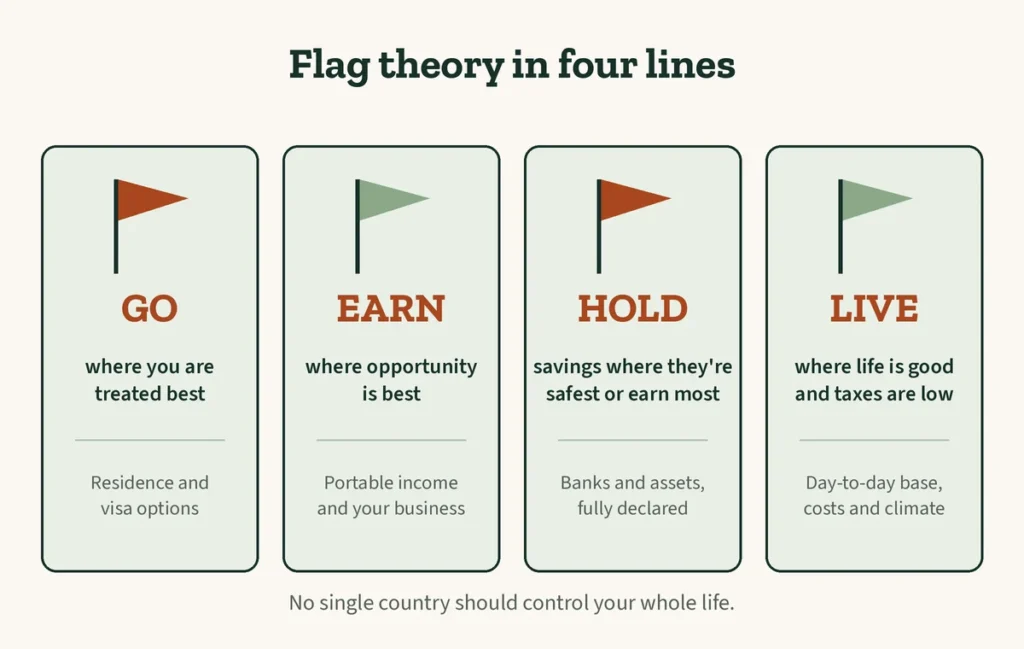
My own version is four lines long:
Go where you are treated best.
Earn where the opportunity is best and the future looks bright.
Hold your savings where they are safest or earn the most.
Live where quality of life is high and taxes are low. Stay away from places whose governments are broke.
The 12 rules below are how I put those four lines into practice.
My four-line version of flag theory.
Part 1: Make your income portable
None of the other flags work if your paycheck is tied to one office in one city.
1. Find the work you’d keep doing anyway
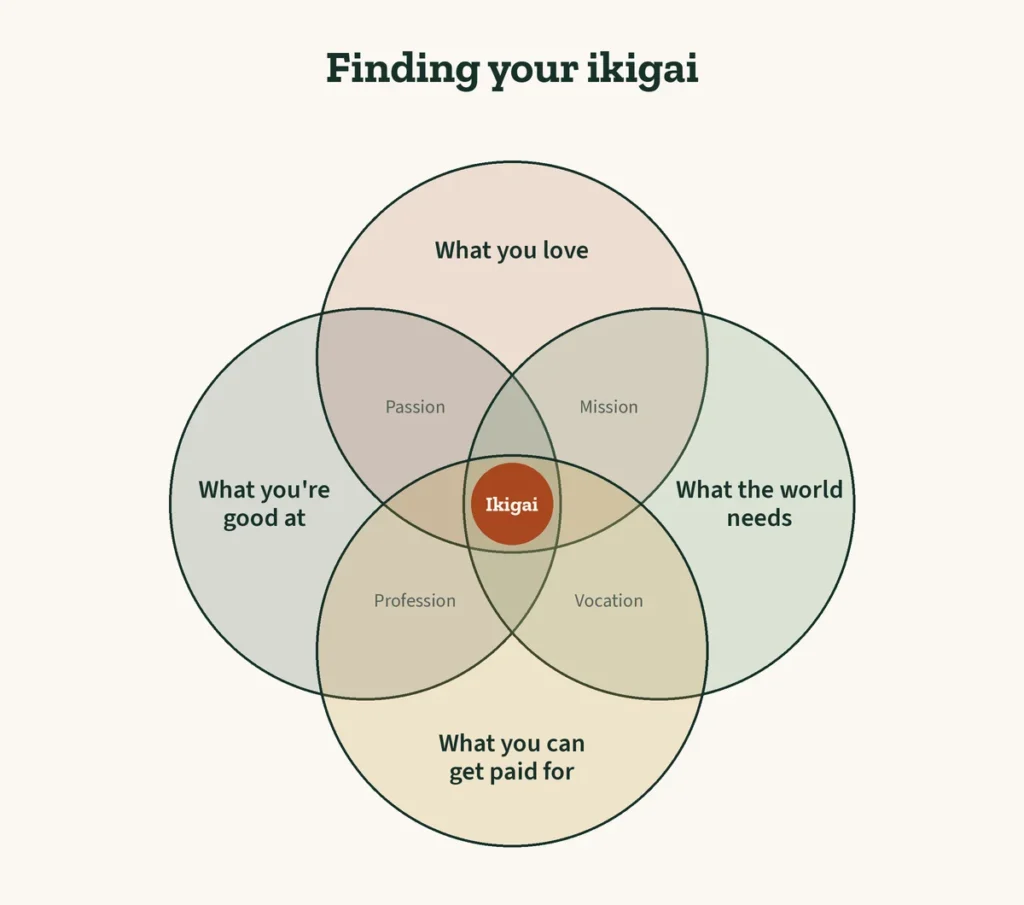
The Japanese idea of ikigai puts it as four overlapping circles: what you love, what you’re good at, what the world needs, and what you can get paid for. The sweet spot in the middle is the work you can keep doing for decades, which matters more once you’re far from home and nobody is checking on you.
Ikigai: the overlap of what you love, what you’re good at, what the world needs and what pays.
2. Find and claim your profitable niche
Spread your time across ten things and you’ll be average at all of them. Look for one profitable niche and work at doing it better than anyone else in it. When you get there, clients find you and you can charge more.
Let’s be honest, though: not everyone finds that perfect niche, and you don’t need it to get started. A skill people already pay for is enough. For many people the niche only shows up after a few years of doing the work.
If you have a choice, lean toward knowledge-based work such as advice, writing, design, software, teaching or bookkeeping. Knowledge travels with you. A shop, a workshop or a fleet of trucks doesn’t.
3. Make your work location-independent
That’s the rule everything else depends on. If your income needs only a laptop and a decent connection, you can move on your own terms instead of when an employer or a visa office says so.
4. Aim for your own business, not a lifetime of wages
A salary ties you to one employer, usually in one country. A business, even a one-person service company, gives you control over where income is earned, how it’s structured and when you can walk away. Start it on the side before you depend on it.
Part 2: Know the money rules before you go
5. Taxes are your biggest expense, so plan them first
Over a working life, most people pay more in tax than for housing, cars or food. Legally reducing that bill is one of the best uses of your time. Don’t move anywhere until you know what you’ll owe there, and what you’ll still owe at home.
Americans need to hear this most. If you’re a U.S. citizen or green card holder, your worldwide income is generally subject to U.S. tax no matter where you live (IRS). You may be able to exclude foreign earned income if you meet the bona fide residence test or spend at least 330 full days abroad in 12 consecutive months, but you only get that by filing a return (IRS FAQ). Moving to a “zero-tax” country does not, by itself, make your U.S. tax bill zero.
6. Use a company to separate business from personal life
A properly run company keeps business liabilities away from your home and personal savings. Depending on where you live and where it’s registered, it can also change how and when income is taxed. The rules for owners of foreign companies are strict, especially for Americans, so set it up with a tax adviser who knows both countries, not from a forum post.
7. Don’t keep everything in one country
If your home, your bank accounts, your business and your passport are all in the same place, one bad policy change hits all of them at once. Spreading them out is not about hiding anything. Every account and company should be fully declared. It’s about making sure no single government or court can freeze your whole life. You don’t have to own everything in your own name, but you must always control it.
8. Get paid first
Whatever the business, collect before you deliver, or at least take a deposit up front. Chasing an unpaid invoice across a border costs more than the invoice is worth.
Part 3: Build a lifestyle that can travel
9. Live below your means
The real secret of getting rich over the long term is boring: spend less than you earn and invest the difference sensibly. Abroad, it also buys you options. A household that lives on 60% of its income can move, wait out a bad year or turn down bad work. (More on this in Stop Keeping Up with the Joneses.)
10. Stay out of debt, and stay quiet about money
Only borrow when the loan will clearly earn more than it costs, which usually means a business asset, not a car or a kitchen. Debt is a leash that ties you to a place and a paycheck.
And if you do well, don’t show it off. As a foreigner you already stand out. Expensive cars, watches and stories about your investments make you a target for scams, inflated prices and worse. The people who stay wealthy longest are usually the ones nobody suspects.
Part 4: Always know how you’ll leave
11. Watch the trend, and leave before it turns
Governments change, rules change, and the frog in slowly heating water never jumps. Pay attention to new taxes, currency controls, exit restrictions and the general mood. If the direction is clearly bad, leave while it’s still easy and cheap to do. I wrote about how earlier generations got this timing right and wrong in Fight or Flight.
Part of the same rule: don’t build your retirement on a government promise. Treat any state pension as a bonus, not the plan.
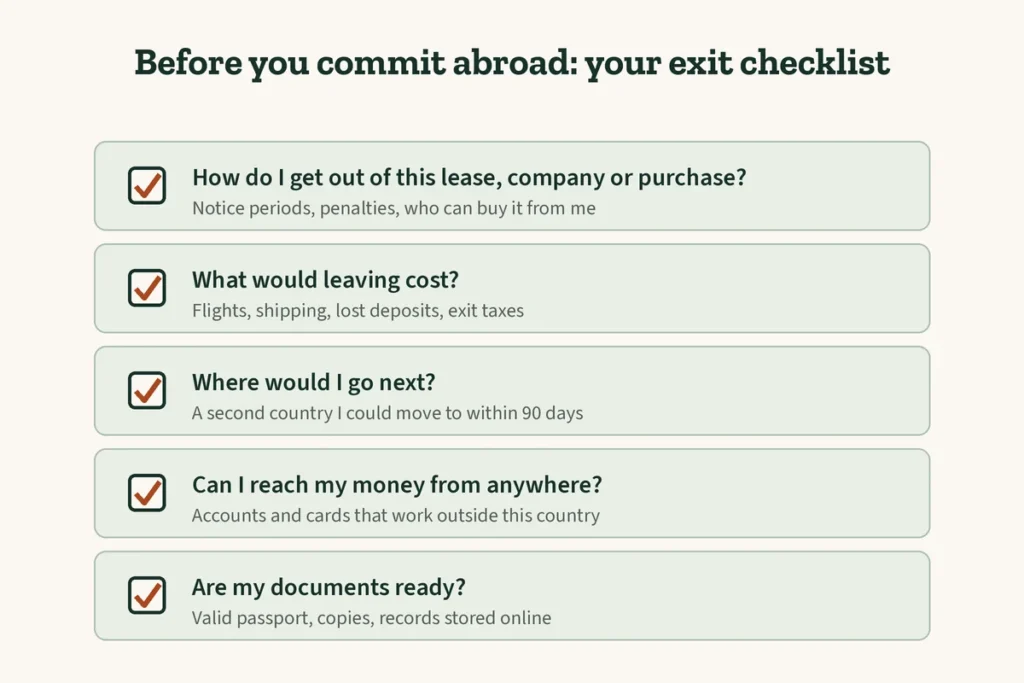
Five questions to answer before you sign anything abroad.
12. Have an exit strategy, and start small
Before you sign a lease, start a company or buy anything abroad, know how you’d get out of it, and what that would cost. Then begin with the easiest wins: a remote client, a trial stay of a few months, a second bank account. Early successes build confidence and show you what works before you take on bigger risks. And never take a risk whose reward isn’t worth it.
Who this is for (and who it isn’t)
These rules suit people who already have some international travel behind them and either have portable income or can realistically build it. If you’ve never lived outside your home country, start with a long trial stay and test ordinary daily life, not a vacation, before planting any flags. Our Cost of Living Abroad comparison is a good place to shortlist where to try.
Flag theory doesn’t mean dodging your obligations. Everything here should be done legally, fully declared and without harming anyone else. Done that way, it simply means not leaving your whole future in one government’s hands.
FAQ
Is flag theory legal?
Yes. Holding residence, accounts or a company in another country is legal as long as everything is declared and you follow the tax and reporting rules of every country involved, including your country of citizenship.
Do Americans still pay U.S. tax if they move abroad?
Generally yes. The U.S. taxes citizens and green card holders on worldwide income wherever they live, although the foreign earned income exclusion and foreign tax credits can reduce or eliminate the bill if you file (IRS).
What’s the first flag an ordinary person should plant?
The easiest is a bank account abroad. Open one and move a portion of your savings there. It takes little time, and it means one bad decision at home can’t freeze everything you have. Keep it fully declared: Americans must file an FBAR once their foreign accounts add up to more than $10,000 at any point in the year (IRS).
Do I need a second passport?
No. It’s useful, but most people get far more from portable income, sensible tax planning and a residence permit in a country that suits them.
Note: This article shares the author’s personal experience and general information. It is not personalized tax, legal or financial advice. Rules change; check official sources and speak to a qualified adviser before acting.