Quick answer
The cheapest states to buy land are in the Mountain West and the Great Plains. Farmland and ranch land in New Mexico averages about 17% of the US price per acre, Wyoming about 23%, and Nevada and Montana about 28%, according to USDA figures for 2025. Oklahoma, Texas and South Dakota sit at about 58% to 68%. In the East, West Virginia, Mississippi and Maine are the cheapest, at about 77% to 82% of the US average.
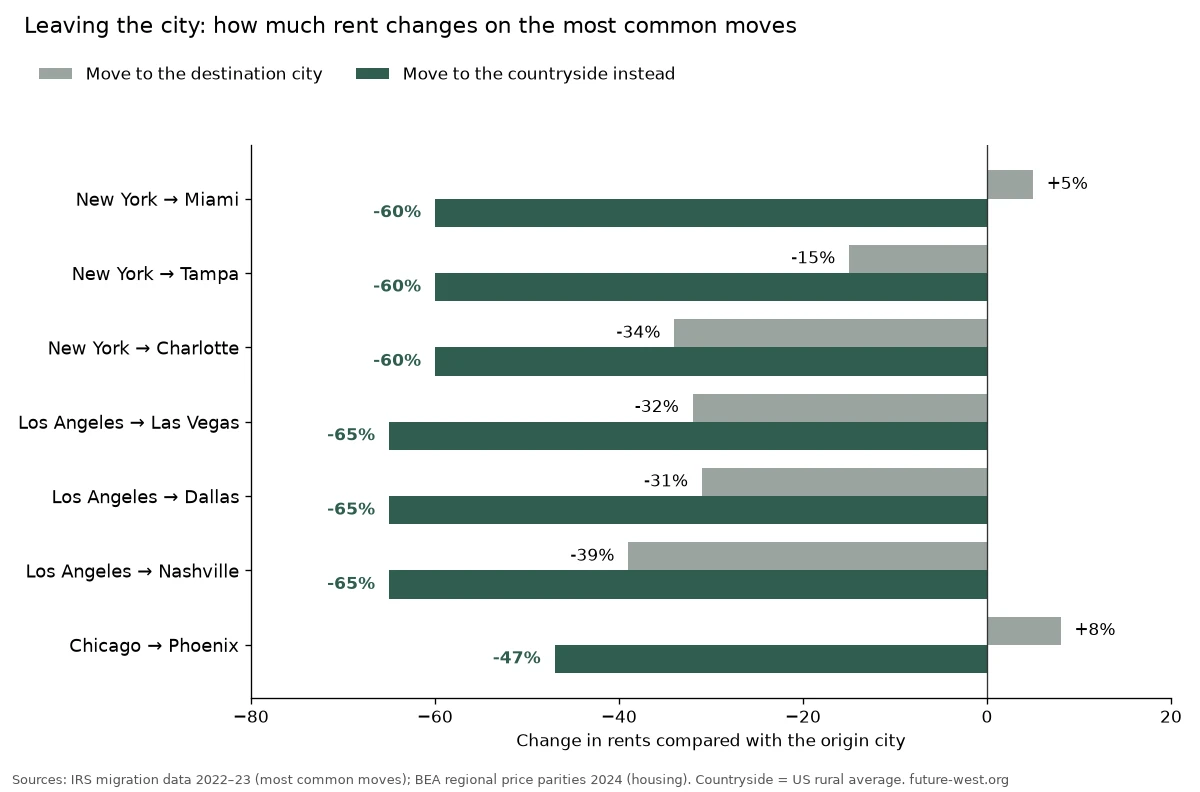
Leaving the city saves the most when you skip the next big city. On the most common long-distance moves, such as Los Angeles to Dallas or New York to Charlotte, rents fall by about 30% to 40%. Settle in the countryside instead and they fall by 47% to 65%. For remote workers who keep their salary and no longer commute, that gap is the real prize.
Note: This article is general information, not financial, tax, legal or real estate advice. Land prices, tax rates and rules change and vary by county. Check current figures and get advice for your own situation.
Where Americans are moving, city to city
Every year, tax returns show where people moved. We used the IRS migration data for 2022–23, grouped counties into metro areas, and counted only moves to another state. Many big cities trade people in both directions, so we ranked each pair by its net flow: households that made the move minus those that moved the opposite way.
| Move | Net households | Rents, city to city | Rents, city to countryside |
|---|---|---|---|
| New York → Miami State income tax: None | 8,121 | +5% | -60% |
| New York → Orlando State income tax: None | 4,097 | -17% | -60% |
| New York → Tampa State income tax: None | 3,924 | -15% | -60% |
| Los Angeles → Las Vegas State income tax: None | 3,783 | -32% | -65% |
| Los Angeles → Phoenix State income tax: Flat 2.5% | 2,645 | -29% | -65% |
| Los Angeles → Dallas State income tax: None | 2,520 | -31% | -65% |
| New York → Atlanta State income tax: Yes | 2,506 | -25% | -60% |
| New York → Charlotte State income tax: Yes | 2,379 | -34% | -60% |
| Chicago → Phoenix State income tax: Flat 2.5% | 1,572 | +8% | -47% |
| Chicago → Dallas State income tax: None | 1,380 | +5% | -47% |
| Los Angeles → Nashville State income tax: None | 1,153 | -39% | -65% |
| Los Angeles → Austin State income tax: None | 1,111 | -29% | -65% |
Rents compare the housing price level of the destination with the origin city, from the federal regional price parities for 2024. The countryside column uses the US average for areas outside metro regions. Income tax shows whether the destination state taxes wages.
What a move really saves
Rent and house prices drive most of the difference. Across all spending, prices in Dallas, Las Vegas, Charlotte and Nashville are about 9% to 15% lower than in Los Angeles or New York. Prices in the countryside are about 21% to 22% lower than in those two cities, and about 14% lower than in Chicago.
Two moves stand out. New York to Miami is the largest move of all, yet Miami is no cheaper than New York, and its rents are slightly higher. These movers have an average income of about $223,000, so the draw is no state income tax, the climate and family nearby. Chicago to Dallas or Phoenix barely changes the price level either. For those movers, jobs and lower taxes do the work.
Taxes add to the saving where they apply. Florida, Nevada, Texas, Tennessee, South Dakota, Wyoming, Alaska and New Hampshire do not tax wages, and Washington taxes only some capital gains. A state with no income tax often makes up for it elsewhere, though: Texas has one of the highest property tax rates in the country.
Why people move, beyond money
Money is rarely the only reason. In United Van Lines’ 2025 movers study, the top reasons for moving to another state were being closer to family (29%), a new job (26%) and retirement (14%). Lifestyle and health followed. Buyers surveyed for the National Association of Realtors’ 2024 migration report chose their new area to be near family and friends (30%), to get more house for the money (21%), for lower taxes (16%) and to live somewhere safer (16%).
For remote workers, space matters most. Among people who moved to another state, the St. Louis Fed found that 44% of those working from home moved for housing, against 23% of commuters. Without a daily commute, a bigger house, a garden and some land move from wish list to budget.
That makes the countryside, and the cheapest states to buy land, the logical next step. If you are leaving one big city anyway, the question is no longer which city, but whether you need to live in one at all.
The cheapest states to buy land in 2026
The table ranks the 15 cheapest states to buy land by the average value of farm real estate per acre, as a share of the US average, from the USDA land values report for 2025. The property tax column shows the effective rate on owner-occupied homes from the Tax Foundation. Where Sustainably Offgrid has a state guide, we link to it.
| State | Land price vs US | Property tax | Income tax |
|---|---|---|---|
| New Mexico | 17% | 0.63% | Yes |
| Wyoming | 23% | 0.53% | None |
| Nevada | 28% | 0.50% | None |
| Montana Montana guide | 28% | 0.61% | Yes |
| Colorado Colorado guide | 53% | 0.50% | Flat |
| North Dakota | 54% | 0.92% | Yes |
| Oklahoma Oklahoma guide | 58% | 0.79% | Yes |
| South Dakota | 68% | 1.00% | None |
| Texas Texas guide | 68% | 1.40% | None |
| Kansas | 71% | 1.21% | Yes |
| Maine Maine guide | 77% | 0.98% | Yes |
| Utah | 80% | 0.48% | Flat |
| West Virginia West Virginia guide | 81% | 0.51% | Yes |
| Mississippi | 82% | 0.58% | Yes |
| Washington Washington guide | 85% | 0.75% | None on wages |
US average = 100%. Farm real estate includes land and buildings on farms and ranches. Small rural parcels near towns usually cost more per acre than these averages.
Read this list of the cheapest states to buy land with care. The cheapest states are cheap for a reason: much of the land is dry range, far from towns, with short growing seasons or hard winters. A 40-acre parcel in New Mexico may have no water at all, while an acre with a well in Tennessee, at about 141% of the US average, may be the better deal. Use the cheapest states to buy land as a shortlist to narrow your search, then judge each parcel on its own.
Cheapest states to buy land by region
- Northern Rockies and Plains (Montana, Wyoming, the Dakotas): the lowest prices per acre and big parcels, but long winters, long drives and few jobs outside towns. Wyoming and South Dakota have no state income tax. For Montana, see where to live off grid in Montana.
- Southwest (New Mexico, Nevada, Arizona): very cheap desert land and mild winters, but water is the limit. Check water rights and well depths first. Sustainably Offgrid covers living off the grid in Arizona and the best Arizona counties for it.
- South Central (Oklahoma, Texas, Arkansas, Mississippi): mild climate, long growing seasons and prices well below the national average. Texas has no income tax but high property taxes.
- Appalachia and the Southeast (West Virginia, Kentucky, Tennessee): wooded, hilly land with plenty of rain. Prices are higher than in the West but parcels come with water. See where to start homesteading in Tennessee and where to live off grid in Kentucky. Further south, read about the top South Carolina counties and buying land in Florida.
- Northeast and Pacific Northwest: more expensive overall, but Maine and rural Washington are exceptions worth a look, and so are parts of Oregon and Pennsylvania.
Price is only one way to rank the cheapest states to buy land. For a wider comparison that weighs climate, building rules and water, see Sustainably Offgrid’s ranking of the best states for off-grid living.
Sustainably Offgrid’s Off-Grid Locations section has 37 guides to US states and Canadian provinces. If you would rather stay in your own state and move to its countryside, start with its guides to California, New York, Illinois and Massachusetts.
The hidden costs in the cheapest states to buy land
Even in the cheapest states to buy land, raw land is only the down payment. Getting it ready to live on often costs as much as the land itself. HomeGuide puts the typical cost of bringing utilities to vacant land at $9,000 to $34,500 or more, with an average of about $22,000.
- Power: running electricity from the road to a house typically costs $2,500 to $12,500. Remote parcels far from a line can cost far more, which is where off-grid solar kits and a backup system come in.
- Water: a complete well costs about $30 to $80 or more per foot, and most residential wells are 100 to 300 feet deep. Where wells are expensive or unreliable, rainwater collection can help, if your state allows it.
- Septic: a conventional system costs about $3,500 to $8,500; an aerobic system averages $10,000 to $20,000. Land that fails a percolation test may need the expensive kind, or a composting toilet where allowed.
- Access: a gravel driveway, a culvert and a legal right of way can add thousands. Make sure the land has deeded access, not just a track across a neighbor’s field.
- Internet: for remote workers, this decides everything. Check the address on the FCC National Broadband Map and read how to get internet off the grid.
- Survey, permits and insurance: a survey costs about $400 to $1,800. Building permits, impact fees and higher insurance in wildfire or flood zones come on top.
How to check a parcel before you buy
Low prices in the cheapest states to buy land attract plenty of bad parcels, but most land mistakes are avoidable. Before you sign, work through this list, and get every answer in writing:
- Zoning and building rules: call the county planning office. Ask what you may build, the minimum house size, and whether you may live in an RV or tiny house while you build. Sustainably Offgrid explains building permits for off-grid cabins and whether living off the grid is legal.
- Water: ask neighbors and local well drillers how deep wells go and how much they yield. In Western states, check who owns the water rights.
- Soil and septic: order a percolation test, and look up the soil on the USDA Web Soil Survey.
- Flood and fire risk: look up the parcel on the FEMA Flood Map Service Center and ask an insurer for a quote before you buy.
- Access and boundaries: confirm deeded road access and get a current survey.
- Title, covenants and minerals: use a title company, read any deed restrictions or HOA rules, and ask whether mineral rights convey with the land.
- Power and internet: get a written quote from the local utility or electric co-op, and confirm a usable internet option.
In the cheapest states to buy land, many parcels sell online, sight unseen. That is common, and risky. Read Sustainably Offgrid’s 12 tips for buying land online, how to find off-grid land and what to look for when buying a homestead before you send a deposit. If you plan a small home, see buying land for a tiny house.
Is leaving the city right for you?
Rural life suits people who like space and quiet, who can fix things or are willing to learn, and who do not mind driving 30 minutes or more to a hospital, a big store or an airport. It is harder on people who need frequent medical care, who depend on public transport, or whose children need specialized schools.
Whichever of the cheapest states to buy land you pick, the safest way in is the same as for a move abroad: test it first. Rent in the area for a season, ideally in winter, before you buy. Meet the neighbors, visit the county office, and find out how long a plumber or an ambulance takes to arrive. If you are weighing a move abroad instead, compare the numbers in our guide to the cost of living abroad, and read Fight or Flight: What History Teaches About Leaving in Time for the bigger picture.
Frequently asked questions
What is the cheapest state to buy land?
New Mexico. Its farm and ranch land averages about 17% of the US price per acre, according to USDA figures for 2025. Wyoming (about 23%), Nevada and Montana (about 28%) follow.
What are the most common moves from big cities?
By net flow in IRS data for 2022–23, the largest moves to another state were New York to Miami, Orlando and Tampa, followed by Los Angeles to Las Vegas, Phoenix and Dallas, and New York to Atlanta and Charlotte. For context, Americans move often, but rarely this far. In 2024, 11.8% of Americans moved, which works out to about once every eight to nine years, and the Census Bureau estimates about 11.7 moves in a lifetime. Only 2.1% moved to another state, so a long-distance move like these happens to the average person only a few times in a life, according to the Census Bureau.
How much can I save by moving from the city to the countryside?
Rents in rural America are about 60% lower than in New York and 65% lower than in Los Angeles, based on federal price data for 2024. Overall prices are about 21% to 22% lower. Moving to another big city instead saves about 30% to 40% on rent on the most common routes.
What does it cost to put utilities on raw land?
Typically $9,000 to $34,500 or more, with an average of about $22,000, covering power, a well or water hookup, septic and gas. Remote parcels can cost much more.
Which states have no state income tax?
Florida, Nevada, Texas, Tennessee, South Dakota, Wyoming, Alaska and New Hampshire do not tax wages. Washington taxes only some capital gains. Check property and sales taxes too, since some of these states charge more there.