
This article is for business owners who can choose where their company lives. If your business runs on knowledge, software or a laptop rather than a factory floor, the BRICS vs G7 shift is not just news. It is a design decision. You can decide which jurisdiction you contract from, which bank gets paid, and in which currency, and you can change that decision as the world changes.
Many business owners in G7 countries feel cornered. Every year brings more regulation, higher taxes and rising costs, while the things that made a place good for business erode: work ethic, punctuality, reliability and the level of education. More and more owners I talk to feel the government is no longer on their side, and they are quietly cancelling the social contract on their own terms by moving the business, or part of it, somewhere else.
Germany is probably the prime example. In a 2026 KPMG survey of finance chiefs at international companies in Germany, 70% ranked it among the five weakest EU countries for regulation, and 47% placed it among the five with the highest and most complex taxes (KPMG). The United Kingdom, the Netherlands and France are not far behind, and in the US, California and New York feel the same way to many owners. Henley & Partners now lists Germany, the UK and France as countries “under pressure” for mobile wealth, and says applications from people with a UK address rose 15% between 2024 and 2025 (Henley & Partners).
The concepts we discuss in this article are not for everyone. They work best for businesses of a certain type: companies that sell knowledge, software or digital services rather than goods from a local shop floor, that can serve clients from anywhere, and that are large enough to justify the cost of running a second entity and a second set of accounts. For example:
- engineering, technical and management consulting firms
- software, SaaS and app developers
- IT, cybersecurity and data services
- digital marketing, design and web agencies
- online publishers, content creators and course businesses
- e-commerce brands that use third-party warehouses
- sourcing agents and international trading companies
- architects, translators and remote recruiting firms
- companies that hold and license intellectual property, such as patents, software or brands
For these businesses, the goal is to future-proof the company and make its operations more versatile. With one entity in a G7 country and one in a BRICS-friendly hub, you can choose how money flows: which entity invoices, which account receives the payment, and whether it is paid in USD, EUR, CAD, HKD or yuan. Multi-currency accounts give you options. You can hold income in the currency you will spend it in, convert when rates suit you, and keep working if one bank, one currency or one corridor runs into trouble.
Quick answer
In the BRICS vs G7 contest, neither side is winning outright, and that is the point. BRICS now has 11 members with about half the world’s population and roughly 41% of world output at purchasing power, against about 10% and 28% for the G7. The G7 still holds around 44% of world GDP in dollar terms, and the US dollar still makes up most central bank reserves. What is ending is the period when one bloc set all the rules. We are heading back to a multipolar world, with several centers of power. My own business has one leg in each: a Hong Kong company and a British Columbia LLP.
Disclaimer: This article is general information, not legal, tax, sanctions or investment advice. Sanctions and export-control rules change quickly and apply to people as well as companies. Before you set up or use entities in different jurisdictions, consult a qualified lawyer and tax adviser in each one.
BRICS vs G7: what BRICS is, and why you rarely hear about it
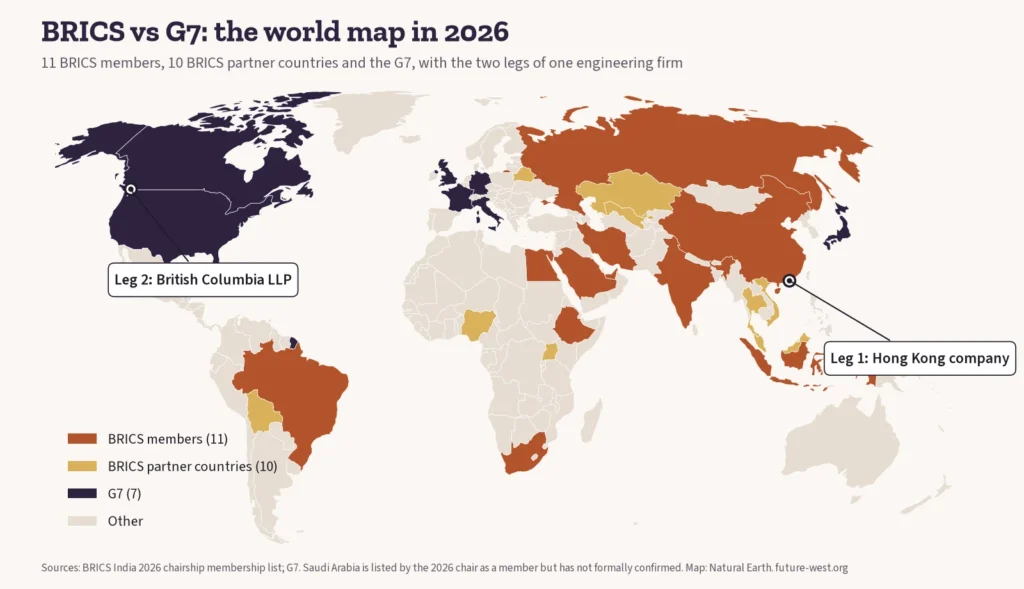
BRICS started as an investment-bank acronym for four fast-growing emerging markets and has grown into an 11-country political and economic coalition, as the Taipei Times recently summarized. The members are Brazil, Russia, India, China, South Africa, Egypt, Ethiopia, Indonesia, Iran, Saudi Arabia and the United Arab Emirates. Ten more countries take part as partners: Belarus, Bolivia, Cuba, Kazakhstan, Malaysia, Nigeria, Thailand, Uganda, Uzbekistan and Vietnam (The Daily Star). Saudi Arabia is counted as a member by the 2026 Indian chair, although Riyadh has never formally confirmed it (Wikipedia).
The membership changes quickly, and maps drawn a year or two ago are already out of date. Of the 13 countries invited as partners at the Kazan summit that year, Indonesia went on to become a full member, and Algeria and Turkey are not on today’s partner list. Here is the map as it stands in late 2026.
If you live in the United States, there is a good chance most of this is new to you. In my experience, even well-read Americans can name the G7 but not the BRICS members. When BRICS does reach American news, it usually arrives as a threat: a tariff warning, or a claim that the bloc wants to kill the dollar. That framing shows. In a 44-country poll by Gallup International, the US had one of the highest negative views of BRICS at 30%, while worldwide one in three people had never heard of it. You cannot plan for a shift you are not told about, so here is what is actually going on.
BRICS vs G7 by the numbers
The 11 BRICS members account for about 49.5% of the world’s population. Using the IMF’s April 2026 figures, they produce about 41% of world GDP at purchasing power parity, against 28% for the G7, and they overtook the G7 on that measure in 2020 (Business Today). When the original four first met in 2006, they made up only 20.4% of the world economy, less than half the G7’s share.
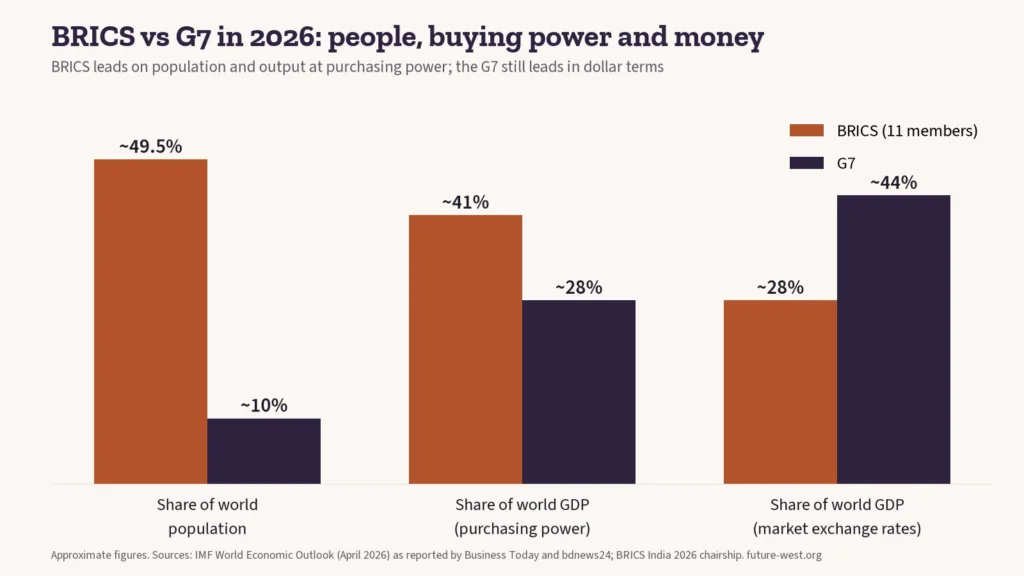
Purchasing power is not the whole story. At market exchange rates, the measure that matters for debt markets and buying foreign machinery, the G7 still holds around 43% to 44% of world GDP and BRICS about 28% to 29% (bdnews24). The dollar also remains the main reserve currency: it was 56.7% of global foreign exchange reserves in the second quarter of 2026, down from 57.2% the quarter before (IMF). The IMF also notes that gold overtook US Treasuries as a share of official reserves in 2025, mostly because the gold price rose (IMF).
So the honest picture is this: BRICS has the people, the growth and a rising share of real output. The G7 still has the money, the reserve currency and the deepest financial markets. Neither side can shut the other out, which is exactly what a multipolar world looks like.
Honest money vs a house of cards
The biggest difference between the two blocs may be money itself. Officially, there is no BRICS currency: at the New Delhi summit, India’s BRICS sherpa said there is “no proposal in the BRICS for a BRICS currency, as of now”, and the declaration backed trade in members’ own currencies instead (The Star). But work on a commodity-backed alternative has started. On October 31, 2025, a Russian research institute, IRIAS, launched a pilot settlement unit called the Unit, backed 40% by physical gold and 60% by a basket of the Brazilian real, Chinese yuan, Indian rupee, Russian ruble and South African rand, with each Unit initially pegged to one gram of gold (Briefs). It is still a prototype for settling trade between banks, not a currency for shoppers, and BRICS central banks have not adopted it (Gold Eagle).
The plumbing for this is being built too, starting with gold vaults. In June 2025, the Shanghai Gold Exchange opened its first vault outside mainland China, at Hong Kong airport, operated by Bank of China (Hong Kong) with 150 tonnes of initial capacity. It is meant as the model for a network of vaults in partner countries; reported candidates include Riyadh, Dubai, Moscow, Kuala Lumpur and Singapore (S&P Global). Hong Kong plans to expand its gold storage tenfold to more than 2,000 tonnes and began trials of a central gold clearing system in July 2026 (Hong Kong Government). In Russia, a senior Duma member proposed in August a joint BRICS gold depository, though that is still only a proposal (KuCoin).
Here is why that matters. Once gold sits in trusted vaults inside the BRICS world, a country or bank can pay another by changing the owner’s name in a ledger, while the bars stay exactly where they are. No ships, no armored trucks, and no need to ask London or New York for permission. That is how gold settled trade for centuries, and it is coming back.
In my view, this is the start of a return to honest money: a unit of account tied to something real that no government can print. Compare that with the G7. The IMF puts G7 government debt at about 124% of GDP in 2026, up from 115% before the pandemic, and projects 133% by 2031 (IMF Fiscal Monitor). Japan’s public debt is about 207% of GDP (IMF). US federal debt passed USD 40 trillion in August and reached USD 40.44 trillion on October 22 (GovFacts, using Treasury data), and interest on it topped USD 1 trillion in a single year for the first time, at USD 1.05 trillion in 2026 (Yahoo Finance).
Hard times create strong men.
G. Michael Hopf, Those Who Remain (2016)
Strong men create good times.
Good times create weak men.
And weak men create hard times.
Remember that line. The novelist G. Michael Hopf wrote it for a post-apocalyptic novel, inspired by the Strauss-Howe generational theory, and he notes that the idea goes back much further, to Ibn Khaldun and Plato. Generations that grew up with cheap credit and endless bailouts have learned to borrow their way out of every problem instead of solving it. The bill for those easy decades is now coming due, and the people paying it will be the ones who never voted for any of it.
When a country borrows to pay the interest on what it already owes, and its central bank buys that debt with newly created money whenever there is a crisis, the system rests on confidence alone. To me, that makes the G7 economies a house of cards: strong-looking, but one shock away from trouble. That is also why central banks have been buying gold, which overtook US Treasuries in official reserves last year. A gold-anchored settlement unit will not replace the dollar soon, but it shows which way the BRICS world wants to go.
Why the rules can change overnight
Washington has answered BRICS with pressure. President Trump has threatened 100% tariffs on countries that try to replace the dollar and, since July 2025, an extra 10% on any country aligning with what he calls the “anti-American policies” of BRICS (WION). This year Congress passed the Graham Sanctioning Russia and Iran Act, which allows tariffs of up to 100% on goods from the five largest buyers of Russian oil or gas, including India and China. Treasury Secretary Scott Bessent said European allies refused to join such secondary tariffs (Lokmat Times). In October, the President waived key provisions for now, but the order keeps watching new purchases, so the risk of fresh penalties remains (Financial Express).
Replacing the dollar is not a declared BRICS goal. Yet the more aggressively the US weaponizes the dollar through sanctions, frozen reserves and tariff threats, the faster its decline will come. BRICS countries want prosperity through stable and predictable business dealings with one another. Every new sanction shows them that trading in dollars carries a political risk they cannot control, and gives them another reason to settle in their own currencies.
For a business owner, the lesson is not who is right. It is that rules can change with one post or one signature, and that your clients, suppliers and banks may suddenly be on opposite sides of a new line.
Why we are heading back to a multipolar world
For most of history, the world had several great powers at once. The decades after the Cold War, when one country and its allies set the financial, trade and technology rules for nearly everyone, were the exception. A multipolar world simply means that power is spread across several centers again: the United States and its G7 allies, China, India, and a group of middle powers such as the Gulf states, Indonesia and Brazil that pick partners deal by deal.
Multipolar does not mean BRICS replaces the G7. BRICS is not an alliance. India and China are rivals, members disagree about wars, and every joint statement has to be carefully worded to keep everyone on board. But you do not need a united bloc to change the balance of power. You need enough large economies that will no longer automatically follow one capital. That is already the case.
How my business stands with one leg in each bloc
My engineering firm works for clients around the world: multinationals with Western headquarters, Asian manufacturers and distributors, and companies in the Gulf. Many of the best-value equipment suppliers in my field are now Chinese. On two projects, large multinational clients excluded Chinese suppliers purely because of geopolitical risk. That was my warning shot.
So I run the business through two entities. The first is a company in Hong Kong. The second is a limited liability partnership in British Columbia, Canada, where partners in a partnership can apply to register it as an LLP under the provincial Partnership Act. Hong Kong gives me a leg in the BRICS world, since it is part of China. Canada is a G7 country.

Why two? Because each side now treats the other’s companies differently. Since December 2020, the US Commerce Department has treated exports to Hong Kong exactly like exports to mainland China (US Bureau of Industry and Security). The Hong Kong government, for its part, says its law lets it apply only UN sanctions, not sanctions imposed by individual countries (US State Department). A Western client’s compliance team may refuse to sign with a Hong Kong company. A client or supplier in the BRICS world may prefer not to depend on a G7 entity that could be ordered to stop work overnight.
With two entities, I don’t have to move contracts around after the fact. I read the signs out there (sanctions lists, tariffs, export rules, where the client is based and where the money comes from) and decide up front whether a new project is better executed through the Hong Kong entity or the Canadian entity. The client gets the same team either way. Sanctions lawyers recommend much the same thing. A guide in Global Investigations Review advises Asia-Pacific firms to separate US-exposed from China-exposed activities, set up regional entities with clearly defined roles and write protective clauses into their contracts.
Continuity, not a loophole: choosing one entity over the other is legitimate only when that entity is allowed to do the work. Each entity must follow the sanctions law of its own country, and the people who own and run it stay bound by the laws of their own citizenship and residence wherever they are. Never route a prohibited deal through the other entity. If a client or project is sanctioned on both sides, the answer is no.
The benefits of having one leg in BRICS and one in the G7
- Each project goes to the right entity. When one side brings in new rules, the next contract is simply signed by the entity that is still allowed to do the work, so clients keep getting served.
- Access to both supplier worlds. I can specify Chinese equipment where clients accept it and Western equipment where they do not, and compare both honestly.
- Two banking channels, many currencies. If one bank becomes nervous about a country, a client or a currency, the business still gets paid through the other. Multi-currency accounts let each client pay in the currency that suits them, and let me decide when, and whether, to convert.
- Two familiar legal systems. Hong Kong and British Columbia both use English-style common law, so contracts read and work in a similar way.
- Trust on both sides. Western clients get a Canadian counterparty; Asian and Gulf clients get a Hong Kong one. Each side deals with an entity it already understands.
- Round-the-clock coverage. Vancouver and Hong Kong are 15 to 16 hours apart, so one leg is usually awake when a client calls.
- Competitive tax. Hong Kong taxes the first HKD 2 million of a company’s profits at 8.25% and the rest at 16.5% (Hong Kong Inland Revenue Department). Better still, Hong Kong only taxes profits that are earned in Hong Kong. If none of your profits come from Hong Kong, the profits tax can be zero, even if the money is paid into a Hong Kong bank account (IRD guide to the territorial source principle). What counts is where the work that earns the profit is done, not just where the client sits. Your company has to file an offshore claim and keep records that prove it, so get an accountant to look at your setup. The BC side works the same way in practice. An LLP pays no income tax itself; its profit flows through to the partners (Canada Revenue Agency). Partners who don’t live in Canada are only taxed on the share earned in Canada, so with no Canadian business, Canadian tax can also be zero (CRA on non-resident partners). Either way, you still owe whatever tax your home country charges, and filing rules apply, so take advice.

Why many BRICS countries are better for a business owner
Beyond sanctions, there is a plainer reason to have a leg in the BRICS world: for many traditional businesses, the numbers work better there.
Younger populations
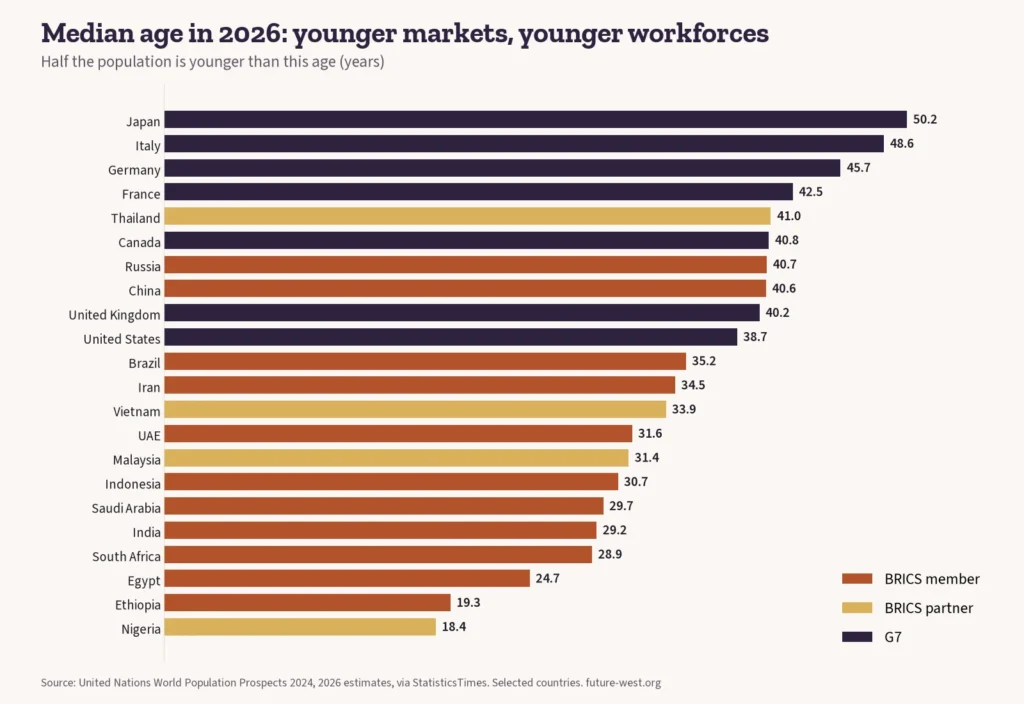
A young population means more workers, more first-time buyers and more people setting up homes and businesses. The United States, at a median age of 38.7, is the youngest G7 country; Japan is 50.2 and Italy 48.6. India’s median age is 29.2, Indonesia’s 30.7, Egypt’s 24.7 and Ethiopia’s 19.3, according to UN estimates for 2026 (StatisticsTimes). Of the 15 BRICS members and partners in the chart below, 12 are younger than the United States. China, Russia and Thailand are the exceptions; they are ageing fast too, which is worth knowing before you build a business there.
Lower labor costs mean less risk
Average US manufacturing pay was USD 30.21 an hour in September 2026 (Trading Economics). Boston Consulting Group puts average manufacturing labor costs at about USD 3 an hour in Vietnam and USD 6.5 in China (Talentnet). Productivity differs, so these figures are not like-for-like, but for a workshop, warehouse, restaurant or small factory, the gap is huge. Lower fixed costs mean a lower break-even point, and a business with a low break-even point survives a bad year. That is the real risk reduction.
More incentives, lighter rules
Many BRICS members and partners compete hard for investors. Thailand’s Board of Investment can exempt qualifying projects from corporate income tax for up to 13 years (Thailand BOI). In the United Arab Emirates, corporate tax is 0% on the first AED 375,000 of taxable income and 9% above that (UAE Federal Tax Authority), and small business relief has been extended until the end of 2029 (UAE Ministry of Finance).
In my experience across Asia, a small business also faces fewer layers of rules than in much of Europe or North America: fewer licenses to start, simpler hiring and less paperwork. That is not true everywhere. India and Brazil are known for complex tax and labor rules, Russia and Iran are cut off by Western sanctions, and lighter rules can also mean weaker courts and sudden policy changes. Pick the country, not the bloc.
What you can do now
- Map your exposure. List where your clients, suppliers, banks and payment providers sit, and which ones could end up on opposite sides of a sanctions line.
- Add a second entity before you need it. Setting one up takes weeks, and bank accounts often take longer. Do it while things are calm.
- Pick the entity per project. Before you sign, check the client, the country and the money flow, then contract through the entity that fits best.
- Spread your money. Hold accounts in more than one banking system and currency, and consider a share in physical assets; see our guide to storing gold and silver.
- Think in flags. Where you live, bank, hold a passport and run your business can be four different places; our flag theory guide explains how.
The balance of power is shifting whether the evening news covers it or not. Historically, the people who did well in such shifts saw them early and moved first, as our article on fight or flight shows. You do not have to choose BRICS or the G7. You can stand in both.
Frequently asked questions
What is the difference between BRICS and the G7?
The G7 is a club of seven rich democracies: the United States, Canada, the United Kingdom, France, Germany, Italy and Japan. BRICS is a looser group of 11 large emerging economies led by China and India, with 10 more partner countries. BRICS has about half the world’s people and more output at purchasing power; the G7 has more wealth in dollar terms.
Is BRICS replacing the US dollar?
Not yet. The dollar was still 56.7% of global foreign exchange reserves in mid-2026, and BRICS leaders have not agreed on a common currency. Members are settling more trade in their own currencies, and a pilot settlement unit backed 40% by gold and 60% by BRICS currencies, the Unit, has been running since late 2025 but has not been adopted by central banks.
What does a multipolar world mean?
A world with several centers of power instead of one. The United States and its allies, China, India and influential middle powers such as the Gulf states and Brazil each pursue their own interests and choose partners deal by deal.
Why would a business have entities in both BRICS and G7 countries?
So it can keep serving clients when sanctions, tariffs or export controls make one entity unacceptable to a client or bank. Before each new project, the owner picks the entity that is allowed to do the work and fits the client best, as long as that entity and its owners comply with all sanctions that apply to them.
Is Hong Kong a BRICS member?
Hong Kong is not a member in its own right; it is a special administrative region of China, which is a founding BRICS member. Since December 2020, the United States has treated exports to Hong Kong the same as exports to mainland China.
Is it legal to choose between entities because of sanctions?
Choosing the entity that is permitted to do the work is legal. Using another entity to get around sanctions that bind you or your company is evasion, and it is illegal. Get advice from a sanctions lawyer before you decide.
Do the Hong Kong and BC entities require trips in person?
For Hong Kong, plan on one trip. The company itself can be registered remotely, but Hong Kong banks usually want at least one director to come to a branch to open the business account; Bank of China (Hong Kong), for example, says at least one director must visit. For the BC LLP, no. You can register it remotely through a local registered-office provider, and if you use Wise Business, which accepts Canadian partnerships, the account is opened online too.
Is BRICS creating a gold-backed currency?
Not officially. The Unit, a pilot launched in October 2025 by a Russian research institute, is backed 40% by physical gold and 60% by five BRICS currencies and is meant for settling trade between banks. BRICS leaders have not adopted it, and India said in 2026 there is no proposal for a BRICS currency.
Setting up a Hong Kong company, a BC LLP or another entity? We can point you to partners we trust for incorporation, tax preparation and auditing.