Quick answer
You probably already own a backup generator: the car in your driveway. A pure sine wave power inverter of up to 2,000 W turns the car’s 12 V into household power (120 V in North America, 230 to 240 V in most other countries) for about USD 200. Add a deep-cycle “house” battery, run the inverter from that battery, recharge it from the car for 2 to 4 hours a day, and you can keep a fridge, a freezer, a furnace blower, a water pump and your router going through an outage. Do not wire it into your house, and keep the running car outdoors, well away from windows and doors.
Disclaimer: This article is general information only. It is not electrical, engineering or safety advice. Electrical work and running engines near a home carry real risks of fire, electrocution and carbon monoxide poisoning. Have any setup planned, installed and checked by a licensed electrician, and follow local codes, permits and the manufacturers’ instructions.
Why an expensive generator is often the wrong buy
A generator is bought for the one storm a decade, then sits in the garage. The fuel in it goes stale, the carburetor gums up, the starter battery dies and the recoil cord snaps on the first pull. Too many of them fail at the very moment they are needed, because nobody ran them for years.
They are not cheap either. A portable generator costs about USD 400 to 2,500, or up to about USD 3,500 with a transfer switch, and an installed whole-home standby generator about USD 8,000 to 23,000, according to Modernize. Bob Vila puts portables at USD 500 to 3,000 and installed standby units at USD 8,000 to 16,000 or more.
Your car is different. You drive it every week, so its engine, battery and fuel are always fresh. It is maintained anyway, it already has a fuel tank, and it is far quieter than a portable generator. All it needs is a way to turn its 12 V DC into household AC, and that is what a power inverter does.
How a car power inverter setup works
While the engine runs, the alternator charges the battery. The inverter takes 12 V DC from the battery and converts it to 120 V or 230 to 240 V AC, depending on your country. You plug appliances into the inverter with extension cords, just as you would with a portable generator.
This video shows the basic idea with a 1,000 W inverter clamped to a car battery, running a gas furnace and a fridge in a power outage:
Video: “Why Buy A Generator? You Have One Parked In Your Driveway.” by The DIY HVAC Guy, on YouTube.
Choosing the right power inverter
- Pure sine wave, not modified sine: fridge and freezer compressors, furnace blowers, pumps and the electronics in modern furnaces need clean power. Modified sine inverters are cheaper but can make motors hum, run hot or fail.
- Up to 2,000 W continuous: enough for a fridge, a freezer and a furnace blower, with room for a pump. A 2,000 W pure sine model costs about USD 200.
- Size for the surge: a motor or compressor briefly draws several times its running power when it starts. The inverter and the battery bank behind it must handle that startup surge, not just the running watts. Check the inverter’s peak (surge) rating and stagger startups.
- Match your country’s voltage: buy 120 V in North America and 230 to 240 V for Europe, Asia, Australia and New Zealand.
- Look for protections: low-voltage shutdown, overload and overheat protection, and a cooling fan.
The wiring scheme at a glance
This conceptual scheme shows how the parts fit together: the car charges the deep-cycle house battery through a fuse and a battery isolator or DC-DC charger, the inverter runs from the house battery, and extension cords carry power to each appliance. Nothing connects to the house wiring.
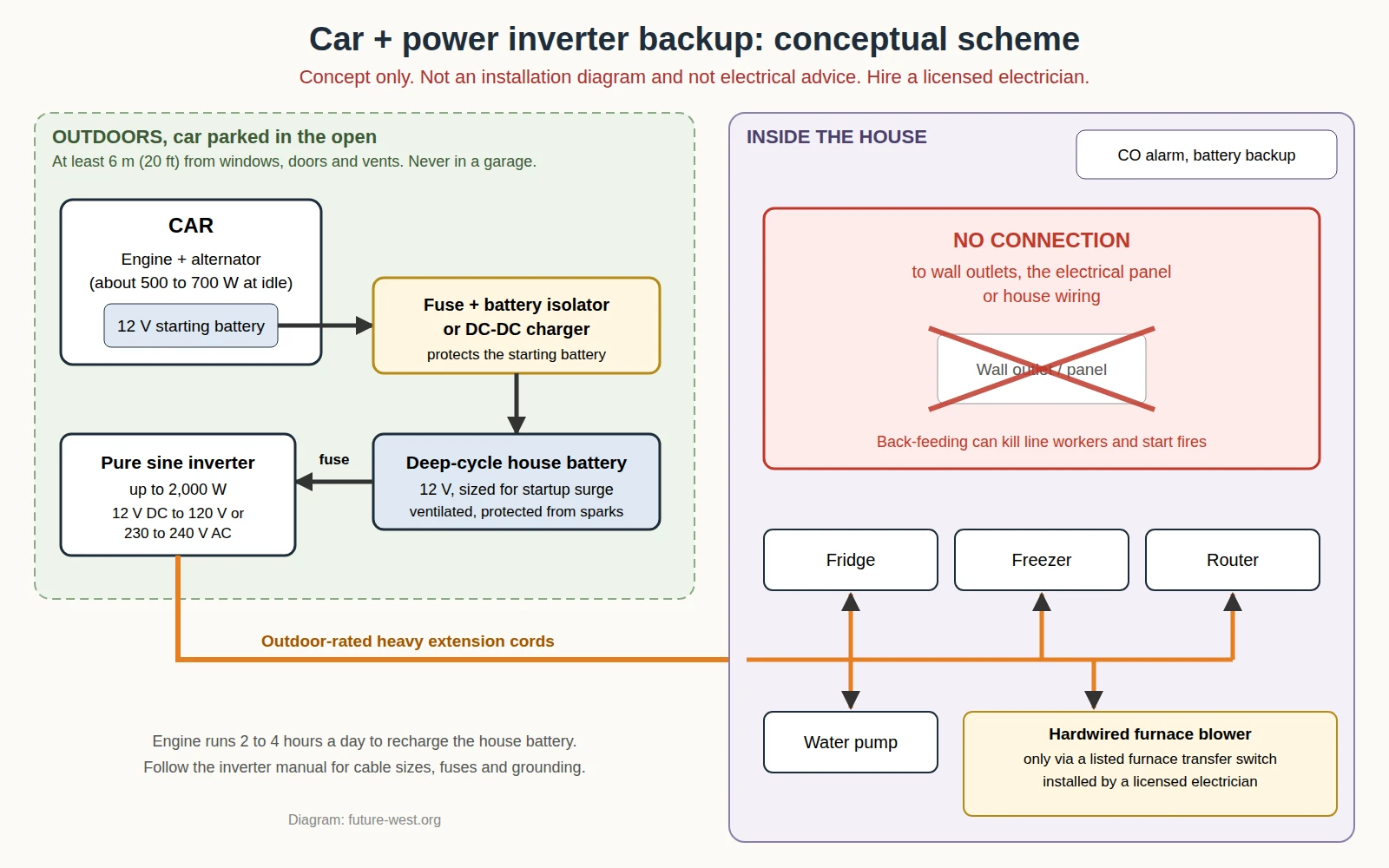
Important: this is a concept, not an installation diagram. It does not show cable sizes, fuse ratings, grounding or local code requirements. Those depend on your equipment and location and must come from the manufacturer’s manual and a licensed electrician.
What it can run
| Appliance | Typical running power | Notes |
|---|---|---|
| Fridge | About 150 W | Runs in cycles; startup surge several times higher |
| Freezer | About 150 W | Can coast for hours if kept closed |
| Furnace blower | Varies by model | Lets a gas or oil furnace heat in winter; needs pure sine power |
| Water pump | Varies, often the largest surge | Check the pump label; may need the full 2,000 W |
| Internet router | Under 20 W | Keeps you online for work and news |
| Phones, LED lights, laptop | Small | Easy to add |
Leave out heaters, kettles, ovens, hair dryers and air conditioners. They draw too much power for this setup.
The better setup: a deep-cycle house battery
Clamping the inverter straight onto the car battery works for a short outage, but a car’s starting battery is built to deliver one big burst, not to be drained for hours. Drain it too far and it is damaged, or the car will not start. The better way:
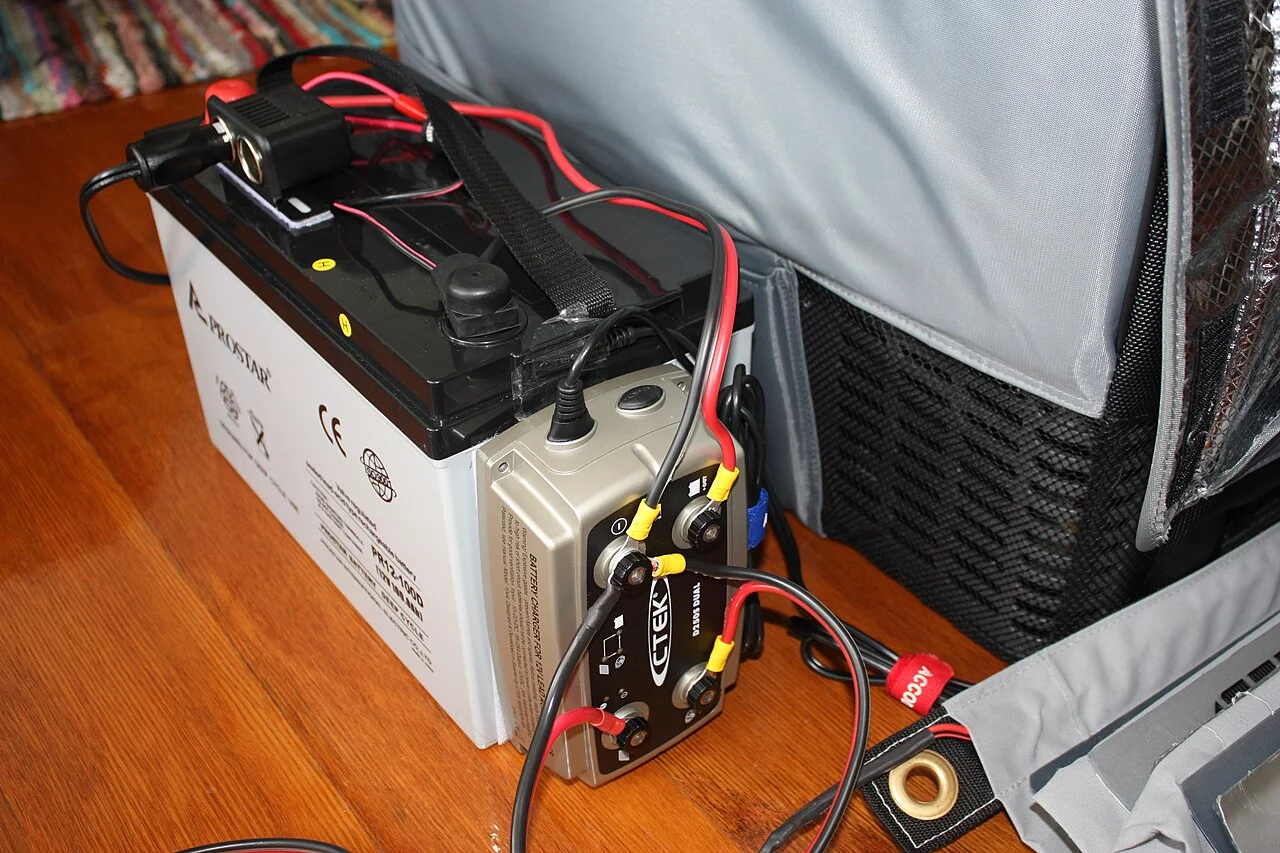
- Get a deep-cycle battery (marine, RV or lithium LiFePO4) to act as your house battery. It is made to be discharged and recharged over and over.
- Run the inverter off the deep-cycle battery, not off the car battery. The house battery covers the startup surges of the fridge, freezer and pump.
- Run a heavy cable from the car battery to the house battery so the alternator recharges it while the engine runs. A battery isolator or DC-DC charger in that line is worth adding: it charges the house battery when the engine runs and disconnects it when the engine is off, so you never drain the battery you need to start the car.
- Run the engine for 2 to 4 hours a day to recharge, ideally split into a morning and an evening session.
How long to run the engine: 2 to 4 hours a day
Be realistic with the numbers. At idle, a typical car alternator can deliver roughly 500 to 700 W to spare. Two hours of idling therefore puts about 1.0 to 1.4 kWh back into the house battery.
A fridge running at 150 W for about a third of the day uses around 1.2 kWh, a freezer about the same, and a router about 0.2 kWh. Together that is roughly 2.5 kWh a day. So plan on 2 to 4 hours of engine time a day: 2 hours if the loads are light, the fridge stays closed and the freezer coasts, up to 4 hours if everything runs. A well-filled, closed freezer keeps food frozen for many hours, so you can power it only every second session.
Fuel use is modest. Idling burns a quarter to a half gallon (about 1 to 2 liters) per hour, depending on engine size, according to FuelEconomy.gov. Two to four hours a day is about 2 to 8 liters (0.5 to 2 gallons). A full tank lasts days, and you can drive to refuel. Keep the tank at least half full whenever a storm is forecast.
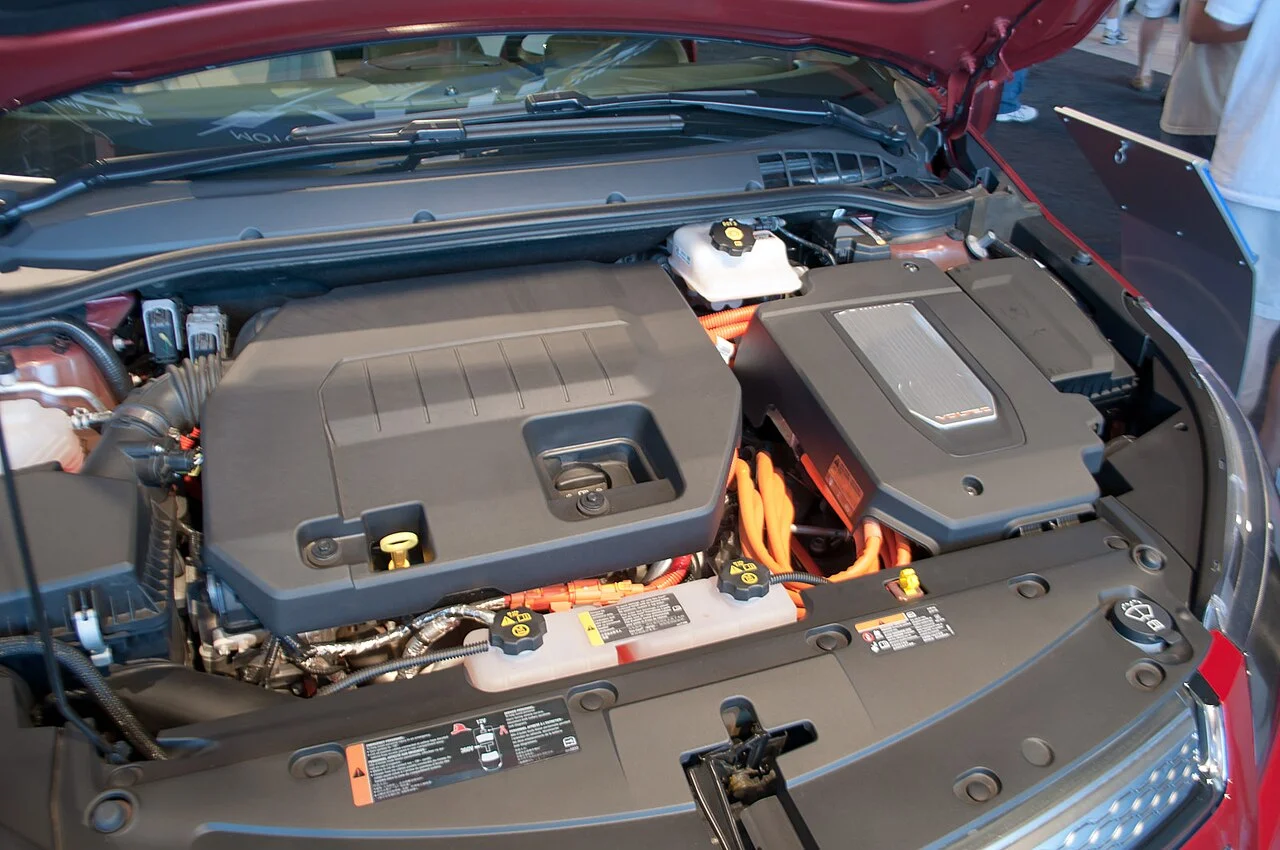
A hybrid car is even better suited: its large traction battery and automatic engine start keep the 12 V system topped up with less idling. Check your owner’s manual for its 12 V output limit first.
Do not wire it into your house
Never connect an inverter, or any generator, to your home’s wiring by plugging it into a wall outlet or the electrical panel. This “back-feeding” can send power out onto the grid and electrocute line workers, and it can start a fire in your home. Plug each appliance directly into the inverter with an extension cord.
A furnace is usually hardwired. The safe way to run it is a listed furnace transfer switch, installed by an electrician, that disconnects the furnace from the house wiring and lets you plug it into the inverter. The video above shows one such switch.
Not handy? Hire a licensed electrician
If you have never worked with heavy battery cables, fuses or high-current DC, do not build this yourself. A licensed electrician, or an auto electrician for the parts inside the car, can:
- size the inverter, the house battery, the cables and the fuses for your appliances
- install the battery isolator or DC-DC charger so your starting battery is protected
- set up proper grounding and a safe, ventilated place for the battery and inverter
- install a listed furnace transfer switch if your furnace is hardwired
- check that everything meets local code and pull a permit where one is required
- show you how to start, run and shut down the system safely
Expect to pay for a few hours of labor on top of the parts. It is money well spent: a mistake with a 12 V battery can still cause burns and fires, and a mistake on the 120 V or 230 to 240 V side can kill.
Safety first
Carbon monoxide (CO) is the biggest danger. It has no smell or color and can kill within minutes. Follow these rules from the CDC and the EPA:
- Never run the car in a garage, even with the garage door open, and never in a carport or any enclosed or partly enclosed space. Park in the open.
- Keep the car at least 6 m (20 ft) from windows, doors and vents, with the tailpipe pointing away from the house, and use extension cords that are long enough.
- Install a CO alarm with battery backup in the house, and test it before winter.
- Never sleep in the idling car, and do not leave a running car unattended.
- Clear snow from the tailpipe before starting, and have the exhaust system checked every year; even a small leak can let CO into the car (CDC).
- Know the symptoms: headache, dizziness, weakness, nausea, chest pain and confusion. If anyone feels them or the alarm sounds, get everyone into fresh air and call emergency services.
Electrical and battery safety matters too:
- Fuse the battery cables. A 2,000 W inverter draws over 170 A from a 12 V battery. Use the short, heavy cables the manufacturer specifies and an inline fuse close to the battery.
- Ventilate lead-acid batteries. They give off hydrogen while charging. Keep sparks and flames away, connect the last clamp away from the battery’s vent caps, and wear eye protection.
- Keep the inverter dry, ventilated and off the hot engine. Do not cover it, and follow its grounding instructions.
- Use outdoor-rated, heavy-gauge extension cords. Do not run them under rugs or through closed doors where they get pinched, and keep connections out of puddles and snow.
- Store fuel safely. If you keep spare fuel, use approved cans and never store them indoors.
What it costs
Prices are typical 2026 US retail ranges and vary by brand, store and region. Electrician labor is not included except where noted.
| Item | Approximate cost | Comment |
|---|---|---|
| Pure sine power inverter, up to 2,000 W | USD 180 to 300 | The core of the setup |
| Deep-cycle house battery, about 100 Ah | USD 150 to 300 (AGM or flooded); USD 200 to 450 (lithium LiFePO4) | Lithium is lighter, usable deeper and lasts longer |
| Heavy cables, fuse, battery isolator or DC-DC charger | USD 100 to 250 | Buy the sizes the inverter manual lists |
| Outdoor extension cords, heavy gauge, 15 m (50 ft) | USD 60 to 150 for two | Long enough to keep the car 6 m (20 ft) from the house |
| CO alarm with battery backup | USD 25 to 50 | Not optional |
| Total | About USD 500 to 1,200 | Depending on battery type |
| Furnace transfer switch (optional) | USD 250 to 500 with an electrician | Only if your furnace is hardwired; the switch itself is about USD 90 |
That is about the price of a small portable generator and a fraction of a standby unit, and none of it sits idle with stale fuel. The house battery can also be charged by a small solar panel. For longer-term backup ideas, see Sustainably Offgrid’s guides to setting up a reliable off-grid backup system and off-grid solar panel kits.
More ways to prepare: our diesel shortage scenario, whether solar and an EV pay back, and why a maxi-scooter can replace a second car.
Final disclaimer: Future West does not give electrical, engineering, legal or safety advice, and accepts no liability for any setup built from this article. Always hire a licensed professional, follow local codes and manufacturers’ instructions, and never run an engine in or near an enclosed space.
Frequently asked questions
Can I use my car as a generator in a power outage?
Yes. A pure sine wave power inverter converts the car’s 12 V into household power. For longer outages, run the inverter from a deep-cycle house battery that the car recharges for 2 to 4 hours a day, and keep the car outdoors.
What size power inverter do I need?
For a fridge, a freezer, a furnace blower and a router, a pure sine wave inverter of up to 2,000 W is enough. Size it, and the battery behind it, for the startup surge of motors, not only their running watts.
Can a car inverter run a fridge?
Yes. A fridge uses about 150 W while running. A pure sine inverter on a deep-cycle battery handles its startup surge and keeps it cold through an outage.
Is it safe to run a car in the garage to power the house?
No. Never run a car in a garage, even with the door open. Park it outdoors, at least 6 m (20 ft) from windows, doors and vents, and use a battery-backup carbon monoxide alarm in the house.
Do I need an electrician for a car power inverter setup?
For anything beyond plugging a small appliance into an inverter, yes. A licensed electrician should size the cables and fuses, install the battery isolator and any furnace transfer switch, and check that the setup meets local code.
Can I plug the inverter into a wall outlet to power the house?
No. Back-feeding through an outlet can electrocute line workers and start fires. Plug appliances directly into the inverter, and use a listed transfer switch installed by an electrician for a hardwired furnace.
I own an electric car. What are my backup power options?
Many EVs have vehicle-to-load (V2L): the Hyundai Ioniq 5, for example, supplies up to 3.6 kW through an adapter or outlet, enough for a fridge, a router and a few lamps, using extension cords as described above (Quartz). A few, such as the Ford F-150 Lightning with Ford’s home backup equipment, can feed the house panel directly with up to 9.6 kW, but only through a professionally installed system with a transfer switch. EVs without V2L can run a small inverter from their 12 V system while switched on; check the owner’s manual for the limit. An EV produces no exhaust, but the rule stays the same: never plug it into a wall outlet.
I drive a hybrid. Is it better for backup power?
Usually, yes. A hybrid’s large traction battery keeps the 12 V system charged and the engine starts only when needed, so it burns less fuel than idling a regular car. Some hybrids, such as many Toyota models, offer a factory 120 V, 1,500 W outlet; Toyota says to park in a well-ventilated place, never a garage, because the engine may start, and not to use it to supply power to a house (Toyota owner’s manual). Run appliances from it with extension cords, or use an inverter on the 12 V battery within the limit in your manual.
Can this setup also run the air conditioner?
No. An air conditioner draws far more power than this setup can deliver, and its compressor needs a large surge to start. That is well beyond a 2,000 W inverter and the 500 to 700 W a car alternator gives at idle, and it would drain the house battery within minutes. Use fans, keep blinds closed in the heat, and save the power for the fridge, freezer, water pump and router.
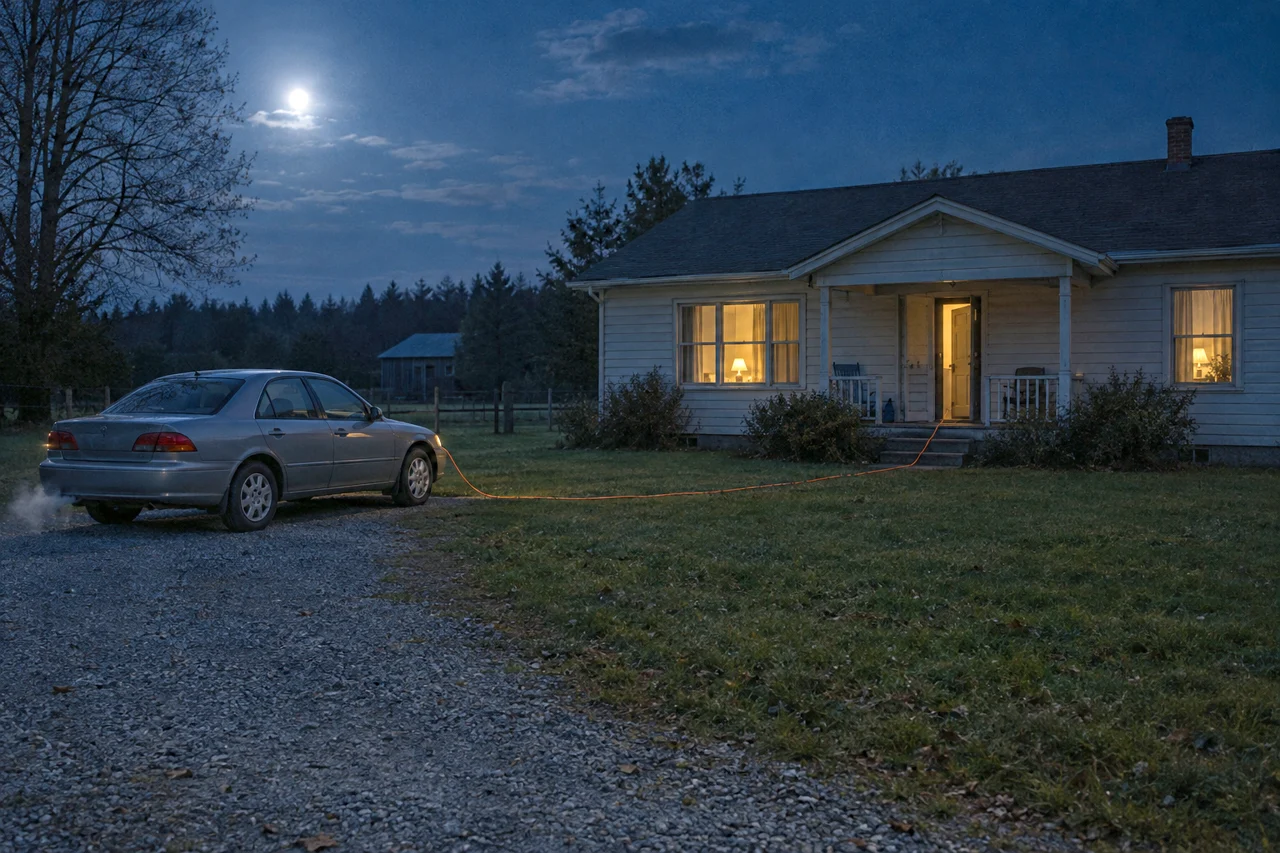
Featured image: illustrative, AI-generated.