Quick answer
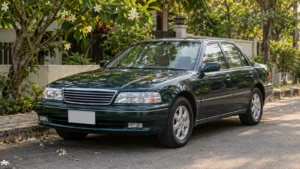
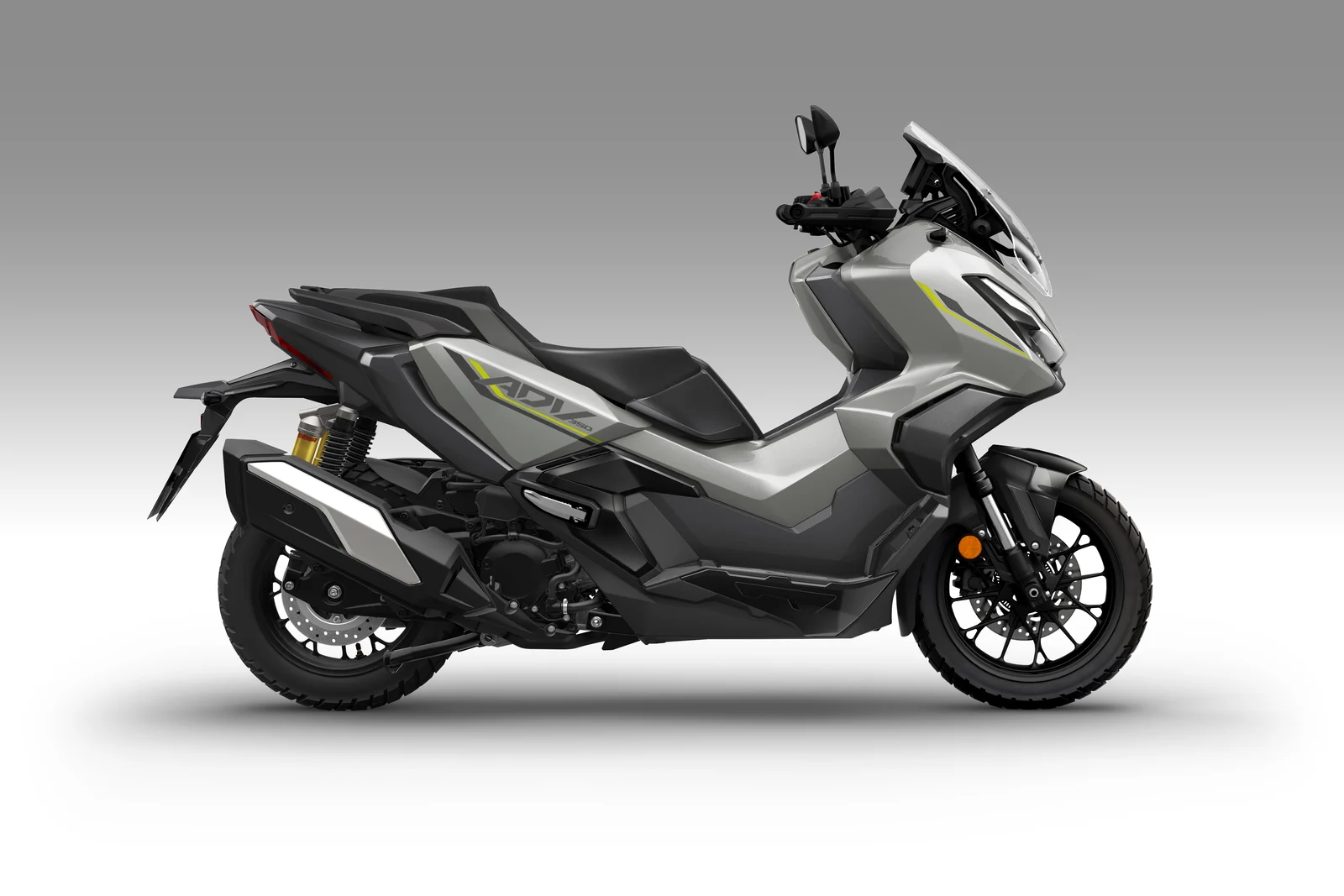
If your household runs two cars, the second one is often the easiest big saving you can make. Keep one car for the school run and the weekly shop, and let the second driver switch to a maxi-scooter such as the Honda ADV350. A new car costs an average of USD 12,863 a year to own and run, according to AAA. Over the same mileage, a 350 cc maxi-scooter costs about 18% of that, even if you write off the whole purchase price.
The trade-off is safety. Per mile (or km), motorcycle riders are far more likely to die in a crash than people in cars, so the switch only makes sense with training, good gear and a sober look at your roads.
Note: This article is general information, not financial, legal or safety advice. Prices, rules and specifications change, so check current details with dealers and local authorities.
Who is this for?
A maxi-scooter replaces a second car best where the weather, the distances and the traffic work in its favor:
- Southern states and warm climates: in the American South, and in places like Thailand, it is a year-round solution. Where winters are long, icy or snowy, it becomes a seasonal vehicle.
- Commutes of up to about 15 km (9 miles) each way: short and medium trips are where a scooter shines. Beyond that, a daily ride gets tiring, especially in heat or wind.
- Inner cities and densely populated areas: where parking costs a fortune and traffic crawls, a scooter saves money on every stop and time on every trip.
- Couples where one car covers the family: one partner keeps the car for children, school and heavy shopping; the other commutes alone.
- Older riders with stiff knees or hips: a step-through scooter is easier to get on and off than a motorcycle.
It is not great in rainy regions. Riding in heavy rain means wet gear, poor visibility and slippery roads, and in places with long rainy seasons you will reach for the car often. It also suits people less if they drive long highway distances or carry children regularly.
What makes a good second-car scooter
A good maxi-scooter covers almost everything a second car does on a normal weekday. We use the Honda ADV350, a 330 cc adventure-styled maxi-scooter, as the example here, with figures from Honda’s 2026 press kit. Most rivals in its class offer similar features.
Storage that replaces a backpack and a top box
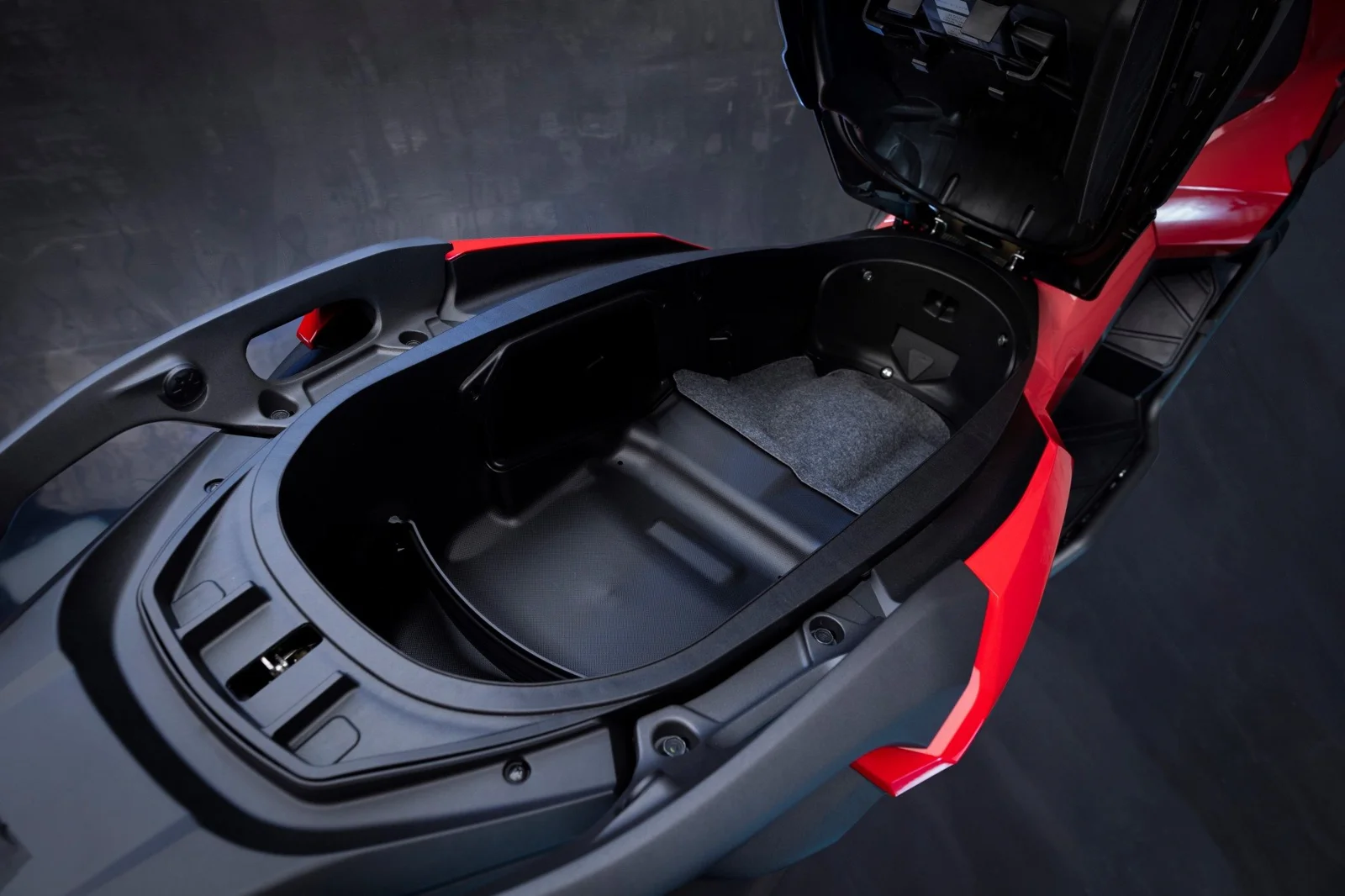
Most maxi-scooters have a large compartment under the seat. On the ADV350 it holds 48 liters, which Honda says fits two full-face helmets. In everyday use that means two large grocery bags, a laptop bag or rain gear, locked away with no backpack and no top box. There is also a lockable glovebox with a USB socket for your phone.
Step in, don’t climb on
Like all scooters, a maxi-scooter has a step-through frame: you step in rather than swing a leg over a tank. On the ADV350 the seat is 795 mm (31.3 inches) high. That makes it easier for older riders and for anyone with bad knees or hips, and it is a bike you can keep riding well into old age. At 186 kg (410 lb), it is not a featherweight, so practice slow-speed turns and parking.
Automatic, with the right gear every time
There is no clutch and no gear lever. The automatic transmission (CVT) keeps the engine at its best speed, so pulling away, overtaking and climbing hills take nothing more than a twist of the throttle. Most current models add ABS, and many add traction control and keyless start.
Agile in the city, fun in the mountains
With around 29 hp (21.5 kW on the ADV350), a 300 to 350 cc scooter keeps up with traffic in the city and on fast roads and is entertaining on winding mountain roads. Adventure-styled models such as the ADV350 go further: long-travel suspension, a 15-inch front wheel and 145 mm of ground clearance handle potholes, speed bumps and gravel tracks better than a typical city scooter.
This is where an adventure-style scooter earns its keep in places like Thailand. Compared with road scooters such as the Honda Forza or PCX, its suspension is more versatile and more forgiving: it soaks up potholes, broken tarmac, rough village roads and the odd dirt track that would jolt you on a low-slung scooter.
It looks and rides like a motorcycle, yet it is a scooter, with all the convenience that brings.
Through traffic, not stuck in it
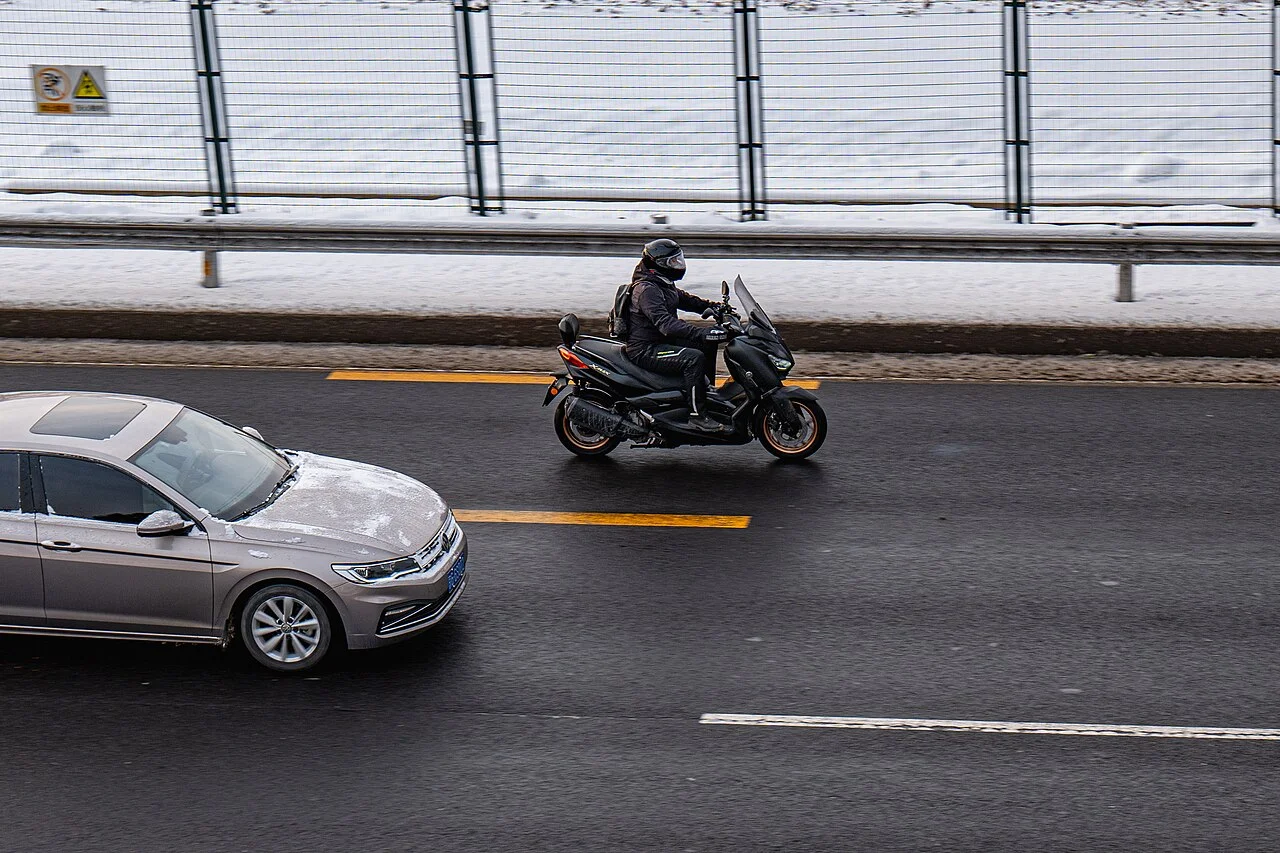
In heavy traffic, a slim scooter can ride between waiting cars to the front at red lights, known as lane filtering. In Thailand, Vietnam, Malaysia and the Philippines, it is everyday practice and saves minutes on every busy junction. In the US it depends on the state: California allows lane splitting, and Arizona, Colorado, Minnesota, Montana and Utah allow filtering under set conditions, according to LegalClarity. Elsewhere it is generally illegal, so check your state’s rules before you try it.
Why a 350 cc and not bigger?
For a second-car replacement, the 300 to 350 cc class is the sweet spot. It has enough power to keep up on faster roads and climb mountain passes with a passenger, yet it stays light enough to handle every day.
- 155 cc can be enough: if you ride mostly in town and rarely leave 50 to 60 km/h roads, a 155 to 160 cc scooter such as the Honda ADV160 or PCX does the job. It is lighter, cheaper and uses even less fuel. It is also the entry level: less intimidating if you are just starting out or new to riding in a country like Thailand. Many riders spend their first years on a small scooter before upgrading, even those who have held a full motorcycle license for decades.
- 500 and 650 cc are heavier than they need to be: bigger maxi-scooters weigh noticeably more. That extra weight shows when you push the bike around, park on a slope or stop on uneven, angled ground, and that is when bikes get dropped.
- More power tempts you to use it: strong acceleration is fun, but it also tempts you to ride faster than traffic allows. For daily errands and commuting, it adds risk more than it adds use.
In short: go for 155 cc if you stay in the city, and 350 cc if you also ride faster roads or mountains. Bigger rarely pays off for this job.
Riding a scooter in Southeast Asia
Thailand, Vietnam, Malaysia and the Philippines are scooter country. Scooters are the everyday family vehicle, so service shops, parts and fuel are never far away.
- Thailand: parking is easy almost anywhere, often right in front of the shop or restaurant, and scooters are left on the street all day in many towns. Owners routinely find them where they left them.
- Vietnam: in Hanoi and Ho Chi Minh City, scooters make up most of the traffic. Expect dense, slow-moving swarms where everyone flows around everyone else.
- Malaysia: roads are generally good, and many expressways have separate motorcycle lanes or shelters under overpasses for sudden tropical downpours.
- The Philippines: scooters and motorcycles are the cheapest way through congested cities like Manila and Cebu, and the easiest way to get around on the islands.
But riding anywhere in the region is not for the faint of heart. Many other road users have little training, and drivers often turn, stop or pull out without warning. To ride safely, you need to:
- Ride extremely defensively: assume others have not seen you and will do the unexpected.
- Anticipate and compensate: watch the car two vehicles ahead, side streets and driveways, and leave yourself room to brake or swerve.
- Keep your full attention on the road, all the time: no phone, no daydreaming, not even on short, familiar trips.
If you are planning a move, compare costs in our guide to the cost of living abroad. Before you ride, check the local license rules. They differ by country, and not every international driving permit is accepted everywhere. Also check that your insurance covers you on two wheels.
What a maxi-scooter costs compared with a car
AAA puts the yearly cost of a new car at USD 12,863, based on 15,000 miles (about 24,000 km) a year over five years. To compare like with like, here is the same mileage on a 350 cc maxi-scooter, using an ADV350 bought new in Thailand for about 204,000 baht (about USD 6,050 at the current exchange rate).
| Yearly cost, 15,000 miles (24,000 km) | New car (AAA) | New maxi-scooter |
|---|---|---|
| Depreciation | USD 4,422 | USD 1,210 |
| Running costs | USD 8,441 | USD 1,050 |
| Total per year | USD 12,863 (100%) | USD 2,260 (18%) |
How the scooter numbers add up:
- Depreciation, USD 1,210: the full purchase price of about USD 6,050 written off over 5 years, assuming zero resale value.
- Running costs, USD 1,050: fuel USD 900 (69 mpg, or 3.4 L/100 km, at AAA’s USD 4.15 a gallon, about USD 1.10 a liter) + servicing USD 120 (1,000 baht every 6,000 km) + insurance USD 30 (Thai compulsory cover). No finance charges, as the scooter is bought outright.
For the car, AAA’s running costs of USD 8,441 cover fuel, insurance, maintenance, finance charges and fees; AAA does not publish each item separately here.
Car figures from AAA Your Driving Costs 2026. Scooter fuel use from Honda (3.4 L/100 km). Scooter figures are an example from Thailand; tires, gear and annual road tax are not included, and insurance beyond the legal minimum costs extra. In the US, expect higher insurance and servicing.
Put simply, the scooter costs about 82% less per year than a second car, even though it is assumed to be worth nothing after five years. In practice a well-kept Honda or Yamaha still has resale value, so the real gap is wider. In Thailand, filling the 11.7-liter tank costs about 360 baht, roughly USD 11, for about 330 km (205 miles).
On top of that, you avoid finance charges and, in many cities, a second parking permit.
The mobility ladder: from cars back to bikes?
In emerging countries, families climb a mobility ladder. People walk first, then buy a bicycle, then a motorcycle, and only later a car. Across Southeast Asia, the motorcycle is the rung most households stand on, and it carries whole families, shopping and small businesses every day.
In G7 countries, the ladder may start to run the other way. With a new car costing about USD 12,863 a year, our view is that more households will be pushed to step down, from two cars to one car and a motorcycle, or from a car to a motorcycle alone, simply to make ends meet. It is not a lifestyle trend so much as arithmetic: a maxi-scooter does most of a second car’s work for less than a fifth of the cost.
Other maxi-scooters to consider
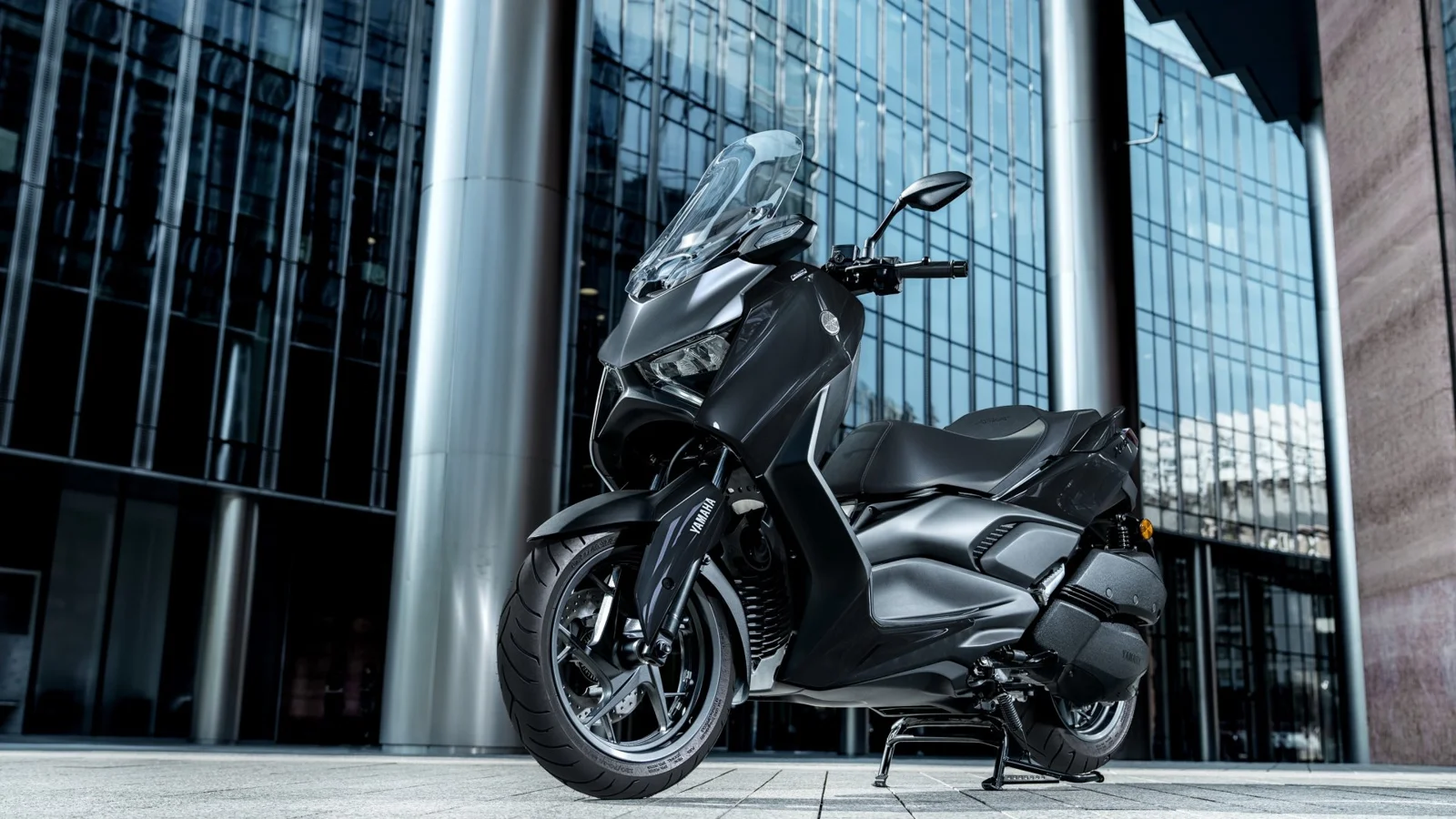
The closest rival is the Yamaha XMAX 300. It is a more road-focused maxi-scooter with a 292 cc engine, a 795 mm seat, a 13.2-liter tank and space under the seat for two full-face helmets, according to Yamaha’s fact sheet. Honda’s own Forza 350 is the road-going sister of the ADV350.
A formidable newer competitor comes from China: the Zontes 368G. It has a 368 cc engine with about 39 hp, roughly a third more than the ADV350, plus a 17-inch front wheel, 180 mm of ground clearance and a 17.5-liter tank good for about 500 km, according to 1000PS. There are 52 liters under the seat, enough for two helmets (iMotorbike), and cruise control and an 8-inch color screen come as standard (Zontes Brazil). In Thailand it lists at about 183,800 baht, around 10% less than an ADV350 (Motorival). The trade-offs are weight, at about 203 kg, and a much smaller dealer and parts network than Honda or Yamaha.
For reliability, stick with Honda or Yamaha. Both have large dealer and parts networks worldwide, which matters more than any spec sheet when something breaks far from home.
Maxi-scooters you can buy in the US
Honda does not sell the ADV350 or the Forza 350 in the US; American buyers get the smaller ADV160 instead, according to RideApart. For a scooter that can handle faster roads, these 2026 models are the closest matches:
| Model | Engine | Price from |
|---|---|---|
| Honda ADV160 | 157 cc | USD 4,499 (Honda) |
| Yamaha XMAX | 292 cc | USD 6,399 (Yamaha) |
| Aprilia SR GT 400 | 399 cc | USD 7,249 (Forbes) |
| Vespa GTS 310 | 310 cc | About USD 7,800 (BikeBound) |
| BMW C 400 GT / C 400 X | 350 cc | About USD 8,445 (Bikes4Sale) |
| Suzuki Burgman 400 | 400 cc | USD 8,949 (Bikes4Sale) |
Base MSRP before destination charges and dealer fees.
The Zontes 368G is not on the list because Zontes has no official US importer, according to CN Auto HR. It sells in Europe, Mexico, Brazil and Southeast Asia, but a US buyer would have no dealer support and would face strict EPA and DOT import rules.
The Yamaha XMAX is the closest US match to the ADV350 in size, price and storage. The ADV160 is cheaper and lighter but better suited to city streets than highways. The KYMCO Downtown GT 350i, launched in the US in spring 2026, and the Piaggio BV 400 S are also worth a look if there is a dealer near you.
Ride safely: the part you should not skip
Per mile (or km) traveled in 2024, motorcyclists were almost 27 times more likely than passenger car occupants to die in a crash and almost 5 times more likely to be injured, according to the US National Highway Traffic Safety Administration. A scooter is no exception.
- Get trained: take a rider course, even if you rode years ago.
- Wear real gear: a full-face helmet, gloves, a protective jacket and sturdy shoes, on every trip.
- Ride to be seen: use headlights, bright gear and keep out of drivers’ blind spots.
- Know your limits: skip the bike in heavy rain, at night on unfamiliar roads, or when tired.
Done this way, a one-car, one-bike household keeps most of the convenience of two cars at a fraction of the cost. For more ways to cut big fixed costs, see Leave the City: Cheapest States to Buy Land.
Frequently asked questions
How much does a maxi-scooter cost per year compared with a car?
At AAA’s 15,000 miles (24,000 km) a year, a new car costs about USD 12,863. A 350 cc maxi-scooter bought in Thailand costs about USD 2,260 a year over the same mileage, or about 18%, even with the whole purchase price written off over five years.
Is 350 cc enough for a maxi-scooter?
For most daily riding, yes. A 350 cc scooter keeps up on faster roads and mountain passes but stays easy to handle. For city-only riding, 155 to 160 cc is often enough. Bigger 500 to 650 cc scooters are heavier, easier to drop on sloped or uneven ground, and tempt you to ride faster.
Can a scooter really replace a second car?
For many households, yes. If one car covers children and heavy shopping, a maxi-scooter like the Honda ADV350 can handle commuting and errands. It works less well for long highway trips in bad weather or for carrying passengers regularly.
How much storage does a maxi-scooter have?
Typically enough for one or two helmets. The Honda ADV350 has 48 liters under the seat, enough for two full-face helmets according to Honda, or about two large grocery bags in daily use, plus a lockable glovebox with a USB socket.
Is a maxi-scooter good for older riders?
It can be. The step-through frame means you step in rather than swing a leg over, and the seat on the Honda ADV350 is 795 mm (31.3 inches) high. At 186 kg it is not light, so practice slow-speed handling before riding in traffic.
What is the best alternative to the Honda ADV350?
In the US, where the ADV350 is not sold, the Yamaha XMAX (USD 6,399) is the closest match. Worldwide, the Yamaha XMAX 300 is the closest rival, with similar seat height and storage for two full-face helmets. Honda’s Forza 350 is a more road-focused option. For reliability and parts, stick with Honda or Yamaha.
Is lane filtering legal?
It depends on where you ride. It is common practice in Thailand and much of Southeast Asia. In the US, California allows lane splitting, and Arizona, Colorado, Minnesota, Montana and Utah allow filtering under set conditions. In most other states it is illegal.
Featured photo: Honda.