

Going into business as a self-employed contractor is less about a bright idea and more about preparation. I left corporate life around 2013 and have worked for clients around the world through my own entities ever since. Looking back, the things that made it work were mostly in place before I sent my first invoice: money in the bank, a reputation, people who already knew my work, a family that backed me, and the right structure.
This guide is for employees with a few years of solid experience who want to sell that skill on their own terms, ideally from anywhere. It is practical experience, not legal or tax advice.
Quick answer
To go into business as a self-employed contractor, save at least one year of living expenses, build a few years of success and reputation as an employee in a field you are good at and enjoy, then call your former bosses and offer your services part time.
Before you start, set up a domain, a clear website and a full LinkedIn profile, because clients will look you up. Choose work you can deliver electronically, so you can serve clients in any country and time zone. Make sure your partner supports you fully, and if you have children, start before they reach school age. Finally, work through an entity rather than in your own name. For me, a British Columbia LLP was the easiest to set up.
Is this for me?
Not everyone is happy as a self-employed contractor, and that is fine. A good salary with a team around you is a perfectly sound choice. Be honest with yourself before you give it up.
It tends to work if you
- Are a self-starter. Nobody tells you what to do on Monday morning, and you get up and do it anyway.
- Are good at what you do and known for it. People already come to you for advice in your field.
- Can live with uneven income. A big month followed by a quiet one does not throw you off balance, because you planned for it.
- Like to sell, or at least don’t mind it. You are comfortable picking up the phone, explaining what you offer and talking about money.
- Enjoy working alone. Long days with only your laptop and the occasional video call suit you.
- Keep your word. You deliver on time, answer emails and do what you promised. Your reputation is your only marketing at the start.
- Adapt quickly. New clients, new tools, new countries and changing rules interest you rather than worry you.
It tends not to work if you
- Need a fixed salary to feel safe. If an empty month keeps you awake even with savings in the bank, contracting will wear you down.
- Need a boss for structure. If you work best with deadlines set by someone else and colleagues around you, you may struggle on your own.
- Dislike selling yourself. Great skills are not enough if you cannot bring yourself to ask for work.
- Are still early in your career. Without a few years of results and a network, there is nobody to call and nothing to show.
- Hate admin. Invoices, contracts, bookkeeping and tax filings are part of the job, or at least managing the people who do them for you.
- Lack support at home. If your partner is against it, the stress will spill into the family.
If most of the first list sounds like you, read on. If the second list hits closer to home, consider testing the idea with one small side project before you resign.
1. Save one year of expenses before you start
This is the rule I would never skip. Put aside at least twelve months of household expenses, not twelve months of business costs. That cushion buys you three things.
- Time to try things. Your first idea of what clients will pay for is rarely the final one. A year lets you test offers, prices and niches without pressure.
- Sleep at night. Slow months happen, and clients often pay 30, 60 or 90 days after the invoice. With a reserve, a late payment is an annoyance, not a crisis.
- No desperation. Clients can smell it. When you need the next contract to pay the rent, you accept bad terms, low rates and the wrong projects. When you don’t, you can say no, and that is when your rate goes up.
The year is much easier to save if you have already moved to a low-cost country or an emerging market. When your household runs on a fraction of what it costs in a G7 city, every month of savings covers more months of living, and the same reserve lasts far longer once you go independent. Our cost of living abroad comparison shows how big the gap can be.
If that number looks impossible, start by cutting your fixed costs. Our guide on how to stop keeping up with the Joneses shows how a lower lifestyle base makes every kind of independence easier.
2. Build a track record as an employee first
Clients hire a self-employed contractor to solve a problem they already know you can solve. That proof comes from a few years of history and success as an employee: projects you delivered, people you worked with and a name in your field. Use your employee years to build that reputation on purpose.
Ideally, that field is one you are both passionate about and good at. The Japanese idea of ikigai puts it as four overlapping circles: what you love, what you are good at, what the world needs and what you can get paid for. Contracting works best in the middle, because you will be doing this work for years, often alone, with nobody pushing you except yourself.
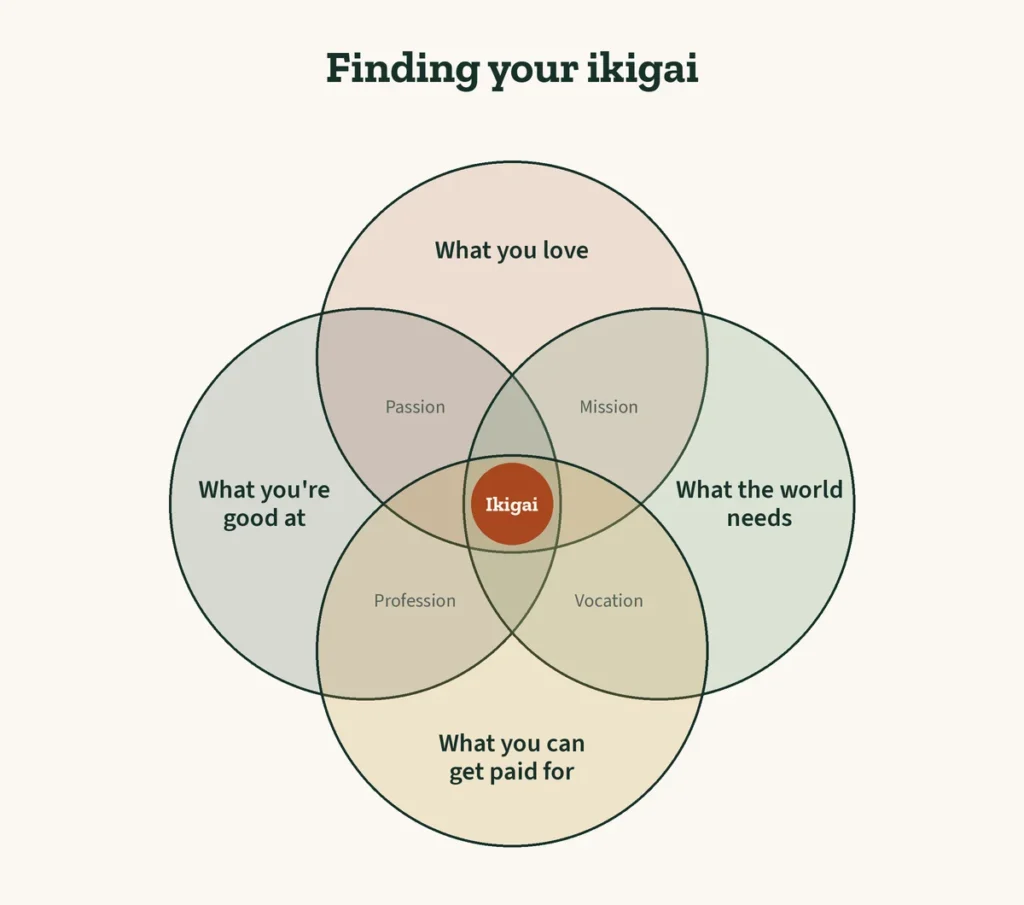
We cover ikigai and finding a profitable niche in more depth in our flag theory guide.
3. Call your former bosses
Your first clients are usually people who have already seen your work. Start calling up your former bosses and managers and let them know you are available on a part-time basis. Many companies have a project that is too small for a new hire but too important to leave undone. A known, reliable person on a part-time contract is an easy yes for them.
This only works if you have not burnt bridges. Leave every job well: finish what you started, hand over properly and stay on good terms, even with the boss you did not like. The industry is smaller than you think, and the manager you annoyed today may run the department that hires contractors in five years.
- Keep a simple list of everyone you have worked for and with, and how to reach them.
- Offer a clear, small first engagement: a few days a month, a defined review or a specific project.
- Ask each contact who else could use your help. Referrals from former bosses carry a lot of weight.
Why clients like a self-employed contractor too
A contractor does not only give you flexibility. It gives your client flexibility as well, and that is often what gets you through the door.
When I started with my first large client, the company was in a hiring freeze. They could not add headcount, but expenses were fine, especially when they were tied to a project that made money. As a contractor I was an expense, not a new employee, so they could bring me in when a permanent hire was impossible.
Large clients also open new locations around the world. Their own employees may not have the adventurous spirit, or simply the bandwidth, to travel to new markets and get things started there. That was another personal experience: I was the one willing to go, and it led to more work.
Successful people are willing to do things that unsuccessful people are not willing to do.
Saying yes to the frozen budget line, the far-away launch or the project nobody else wants is exactly what opens doors to new opportunities.
4. Choose work you can deliver electronically
If you want to work remotely, you need to be in a business where the work can be delivered electronically: reports, drawings, designs, code, analysis, advice. Meetings happen on Zoom or Microsoft Teams. Avoid in-person attendance as much as possible, and when a client insists, price the travel time properly.
The payoff is scale. Without the need to be on site, you are not limited to clients within driving distance. You can accept international clients across time zones, and one client in a slow economy no longer decides your year. My own clients sit in Western countries, Asia and the Gulf, and the time difference often works in my favour: work can be done while the client sleeps.

This also opens the door to living somewhere cheaper while earning international rates. See our cost of living abroad comparison for what that can mean for a household budget.
5. Get your household behind you
Going it alone is easier when you are alone. You carry the risk, you make the decisions and nobody else has to adjust.
With a partner, he or she must support you 100%. Not 70%, not a reluctant OK. There will be months with no income, evenings on calls with clients on the other side of the world and moments when you doubt yourself. If your partner is not fully on board, either your business or your partnership will fail, and often both.
If you have kids, the right time to start is before they reach school age. Small children move with you, and your hours can follow the family rather than a school timetable. Once school starts, your location, holidays and daily rhythm get fixed, and taking a risk with the family income feels much heavier.
6. Get your website and LinkedIn ready before you need them
These are things you can prepare while you are still employed, and they cost little. The first is a domain and a website. Not because of traffic: a self-employed contractor’s site will not bring many visitors.
The point is that people will look you up the moment you send your first email from your company address. A well-structured site with a clear offering, who you help, what you deliver and how to reach you, gives you instant credibility. This is one mistake I made. I waited too long, and I wish I had done it much earlier.
- Domain and company email. Register a domain in your business name and send every client email from it, not from a free webmail address.
- A simple, clear website. A few pages are enough: what you offer, the kind of projects you have done, a short profile and a contact page.
- A complete LinkedIn profile. Treat it as your electronic CV, with your roles, projects and achievements written out. Then add the link to your email footer, next to your website. Anyone you write to can instantly check your work history and experience.
- A consistent story. Your website, LinkedIn profile and email signature should describe the same offering in the same words.
If you are entrepreneurially minded, go one step further and build up digital marketing as a skill: websites, search engine optimisation, email newsletters and social media. First you use it to help yourself, because it brings clients to your own business. Later it can become a niche of its own, helping others do the same.
Being a self-employed contractor with these skills can also open doors for the family. Your wife or husband may want to work from home as well, with a monetized blog or as a contractor in their own niche, and the same skills get them started much faster.
7. Work through an entity, not in your own name
I have always worked as a self-employed contractor through a corporate entity, never in my own name. Two reasons stand out.
- Freedom in taxation. An entity lets you choose where the business is based, how profits are taxed and when money is paid out to you. Tax rates differ enormously between countries; the Wikipedia list of countries by tax rates gives a quick overview of corporate and personal rates around the world.
- Protection of your personal assets. A properly run entity separates the business from you. If a project goes wrong and a client sues, the claim is against the business, not against your house or savings.
Not a loophole: an entity organises your affairs; it does not erase your personal tax obligations. Those apply both at home and in your new country of residence, and filing rules apply in every country involved. Also look up the CFC (controlled foreign corporation) rules in your anticipated country of residence: many countries tax a resident’s share of a foreign company’s profits even when nothing is paid out. US citizens fall under the US CFC rules wherever they live; the IRS explains them in its overview of CFC and Subpart F income for individual shareholders. Get accountants in each country to check your setup before you sign the first contract.
Countries with no or lax CFC rules
If you plan to move, it helps to know which countries do not apply CFC rules at all. According to PwC’s Worldwide Tax Summaries (reviewed in 2026), these have no CFC rules:
- Europe: Switzerland, Georgia, Montenegro and Serbia.
- Asia: Singapore, Hong Kong, Thailand, Malaysia, the Philippines and Vietnam.
- Latin America: Panama, Costa Rica and Paraguay.
Some countries have CFC rules, but they are lax for a consulting business:
- Uruguay has no CFC rules for companies, only rules that apply to individuals.
- Canada applies its rules to Canadian corporations, and they target property income and income from a business other than an active business. Active business income is generally left alone.
By contrast, Taiwan introduced CFC rules in 2023. Keep in mind that no CFC rules does not mean no tax: dividends you pay out to yourself, or foreign income you bring into the country, may still be taxed, and the rules change. Check the current position with an accountant before you move.
Why a BC LLP was the easiest entity for me to start
I run my business through a Hong Kong company and a limited liability partnership (LLP) in British Columbia, Canada. Of the two, the BC LLP was by far the easiest to set up. Here is why it works well for a self-employed contractor:
- No residency needed. The BC government states that you do not need to be a resident of BC to start a business there (Government of British Columbia).
- Low cost. Registering an LLP costs a CAD 275 government fee, filed on a simple registration statement (same source).
- Done remotely. I never had to travel. A local registered-office provider gives you the required BC address and files the paperwork.
- Real liability protection. Under the BC Partnership Act, a partner in an LLP is not personally liable for the partnership’s obligations simply because they are a partner. You stay liable for your own negligence, which is fair.
- Simple tax. An LLP pays no income tax itself. Its profit flows through to the partners, and partners who do not live in Canada are generally taxed in Canada only on income earned there. Your home country still taxes you as usual.
- A trusted G7 address. Western clients are comfortable signing with a Canadian counterparty, and the common-law contracts read the way they expect.
The bank account is often the bigger hurdle. Registering the entity is the easy part. Opening a business bank account for it is where many people get stuck: traditional banks often want you to visit a branch, ask for a local address and take weeks to review a foreign-owned partnership. I opened mine remotely with Wise Business, which accepts Canadian partnerships, and the whole process ran online.
Wise is not the only option. Similar online providers offer multi-currency business accounts, but each one decides which countries and entity types it accepts, so check before you apply:
- Airwallex offers a Canadian business account with 20+ currencies and local account details for collecting payments from abroad.
- Payoneer operates in Canada and is built for receiving payments from international clients and marketplaces.
- Revolut Business works well for entities in the UK, Europe, the US, Singapore or Australia, but is not currently available to Canadian businesses.
- A traditional Canadian bank remains an option, but expect more paperwork and often a visit in person.
A few requirements to know: a partnership needs two or more partners, for example you and your spouse, the LLP must keep a registered office in BC, and its name must end in LLP. I explain how my BC LLP and Hong Kong company work together, including the tax details, in BRICS vs G7: how to do business in both.

Your self-employed contractor checklist
- Twelve months of household expenses saved.
- A few years of success and a good name in a field you enjoy and are good at.
- A list of former bosses and colleagues, with no burnt bridges.
- A service that can be delivered electronically, with meetings on Zoom or Teams.
- A domain, company email, a clear website and a complete LinkedIn profile linked in your email footer.
- A partner who supports you fully, and a start date that suits the family.
- An entity set up and a bank account open before the first invoice.
Setting up a BC LLP, a Hong Kong company or another entity? We can point you to partners we trust for incorporation, tax preparation and accounting.
Frequently asked questions
How much money should I save before becoming a self-employed contractor?
At least one year of household living expenses. It gives you time to test offers and prices, covers slow months and late payments, and keeps you from accepting bad contracts out of desperation.
How do I find my first clients as a self-employed contractor?
Start with people who already know your work. Call former bosses and colleagues, tell them you are available part time and offer a small, clearly defined first project. Ask each of them for referrals.
Can a self-employed contractor work for international clients?
Yes, if the work can be delivered electronically. Reports, designs, code and advice can be sent from anywhere, and meetings can run on Zoom or Microsoft Teams, so clients in other countries and time zones become possible.
Should a self-employed contractor work through a company?
In my experience, yes. An entity gives you more freedom in how and where profits are taxed and separates business liabilities from your personal assets. Your personal tax obligations at home and in your new country of residence also apply, so get advice from accountants. Also look up the CFC (controlled foreign corporation) rules in your anticipated country of residence.
Does a self-employed contractor need a website?
Yes, but not for traffic. Prospective clients will look you up as soon as they get an email from your company address. A clear website and a complete LinkedIn profile, linked in your email footer, give you instant credibility and let people check your experience.
Is a BC LLP easy to set up from abroad?
It was for me. You do not need to live in British Columbia, the government fee is CAD 275, and a registered-office provider can supply the required BC address and handle the filing. You need at least two partners and the name must end in LLP. When evaluating corporate entities, look out for jurisdictions with territorial taxation. These jurisdictions tend not to tax international income that comes from outside their borders.